Transaction Categorization API: Why Automated Classification Fails and How Enrichment Fixes It
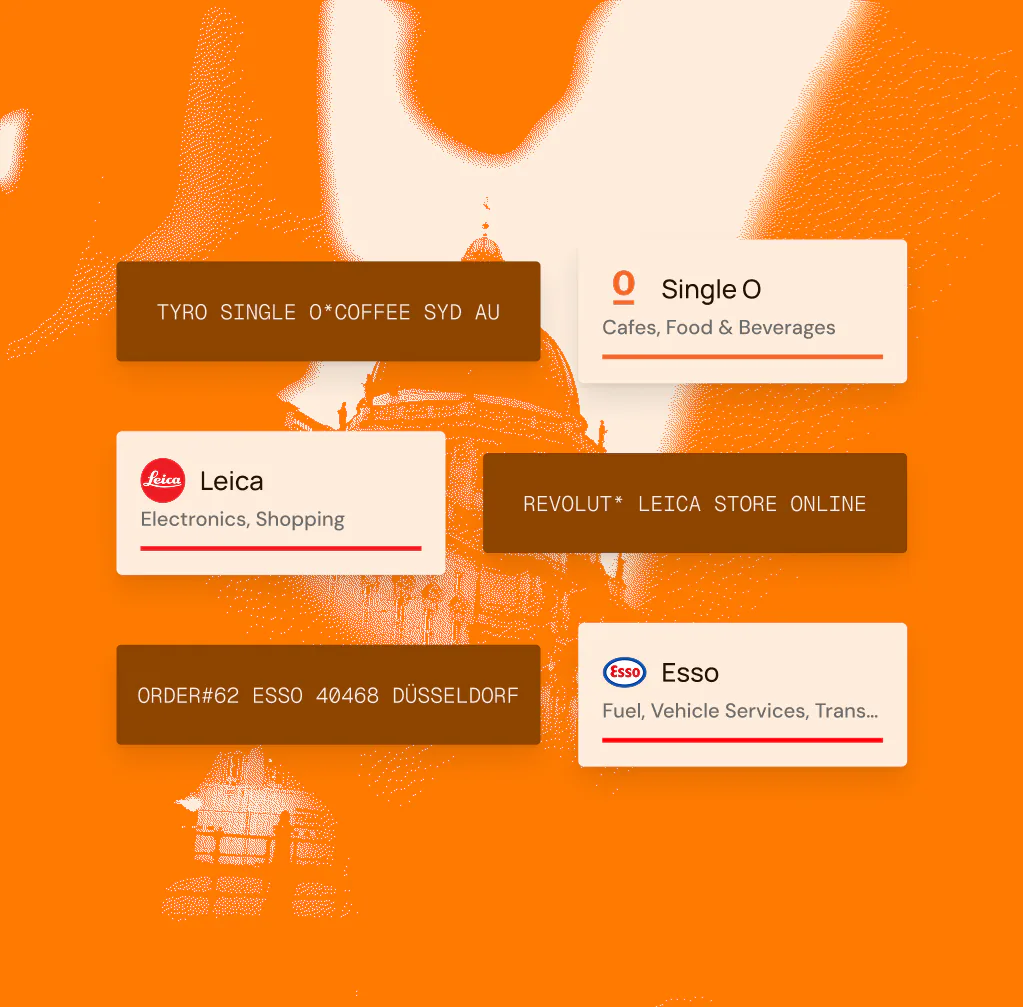
Transaction categorization looks like a solved problem until you actually try to build it. Users expect their banking or budgeting app to instantly understand what every transaction means: groceries versus dining, rent versus utilities, work expense versus personal spend. When that expectation is not met, trust drops fast. A user who sees their Uber Eats order categorized as "Transportation" or their gym membership filed under "Shopping" will question whether the app understands their finances at all.
For developers and product teams, delivering consistently accurate transaction categorization is far more complex than it appears from the outside. The data is ambiguous, the signals are weak, the edge cases are endless, and the problem is fundamentally probabilistic rather than deterministic. This article explains why automated transaction categorization is inherently difficult, why common approaches like MCC codes and rule-based systems fail at scale, and how modern transaction enrichment APIs make categorization dramatically simpler by solving the problem upstream.
What Transaction Categorization Actually Requires
Categorizing a transaction is not a single step. It is a pipeline of decisions, each carrying uncertainty, and errors at any stage compound downstream.
To accurately categorize a transaction, a system must first parse the raw transaction string, cleaning noisy text, removing internal bank identifiers, date fragments, and payment processor artifacts to extract usable signals. Then it must recognize the merchant, identifying the specific brand, store, platform, or entity the user paid, which is often obscured by truncation, abbreviation, or intermediary injection. Next comes contextual understanding: analyzing the payment channel (online versus in-store), the location, whether the transaction is recurring, and what the amount and timing suggest about intent. Then comes user intent inference, determining whether this is a personal purchase, a business expense, a subscription renewal, a money transfer, or a one-time discretionary spend. Finally, all of these signals must be mapped to whatever category model the application uses.
A failure or shortcut at any step reduces transaction categorization accuracy at every step that follows. And this entire pipeline must execute reliably across millions of transactions from hundreds of banks in dozens of countries, each with their own formatting conventions and quirks.
Why Raw Bank Transaction Data Defeats Simple Categorization
Bank transaction descriptors were never designed for semantic understanding. They were optimized for clearing and reconciliation between financial institutions, a purpose that requires unique identifiers and processing codes, not human-readable merchant names or spending categories.
A single real transaction might appear as SPOTIFY AB STO PAYMENTS 08-12 SE on one bank feed and SPOTIFY PREMIUM on another, or as SP * SPOTIFY through a different processor. The actual content that a user paid for, a music subscription, is nowhere in the raw data. The system must infer it from fragments.
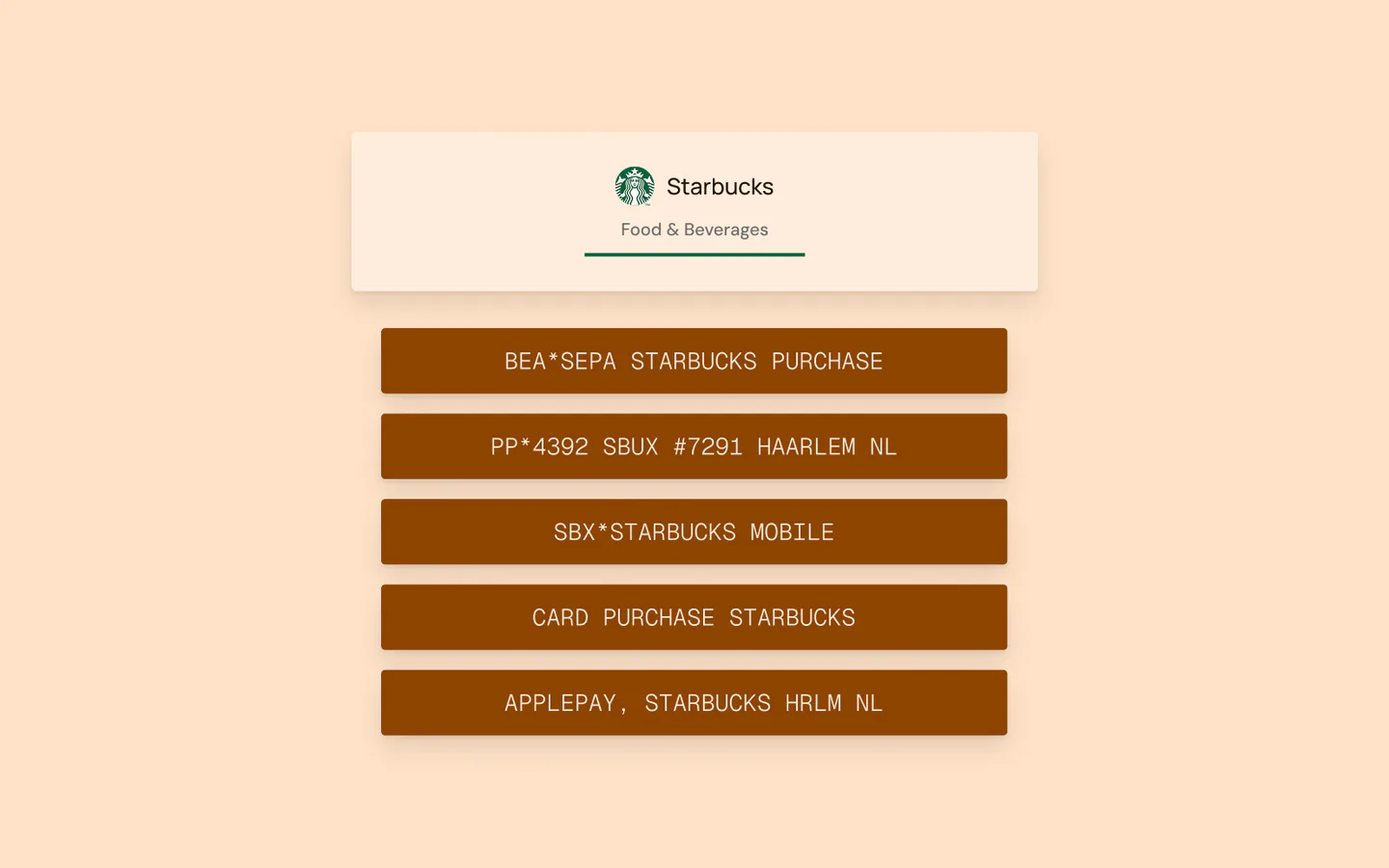
This problem is not limited to obscure merchants. Major global brands appear in dozens of different formats across banks. A Starbucks transaction might show as STARBUCKS #12345 SEATTLE, SBX*STARBUCKS MOBILE, STARBUCKS CORP PAYMENT, or CARD PURCHASE STARBUCKS depending on the bank, the payment method, the country, and how the transaction was routed. Building categorization rules that reliably identify every format for even the top 1,000 merchants requires enormous manual effort, and that effort must be continuously maintained as formats change.
Where MCC Codes Fall Short for Transaction Categorization
Many categorization systems rely heavily on Merchant Category Codes, four-digit codes assigned by card networks like Visa and Mastercard to classify merchants by their primary business type. MCC codes have the appeal of being standardized and widely available, but their limitations for transaction categorization are well documented and significant.
MCC codes describe the merchant, not the transaction. When you buy groceries at a Target or Walmart, the MCC code reflects "discount stores" or "variety stores," not "groceries." When you order dinner delivery through Uber Eats, the MCC might reflect "transportation" because that is Uber's primary business classification. The disconnect between what the merchant is and what the user actually purchased makes MCC codes unreliable for consumer-facing categories.
MCC codes are assigned inconsistently and rarely updated. The same type of business may receive different codes from different acquirers. A coffee shop might be coded as "eating places" or "quick service restaurants" or "miscellaneous food stores" depending on how it was registered. Once assigned, codes are seldom reviewed, so merchants that change their business model keep outdated classifications.
Modern business models break MCC assumptions. Platforms like Amazon, where a single transaction could represent groceries, electronics, books, or digital subscriptions, receive a single MCC code that cannot distinguish between these fundamentally different purchase types. Super apps, marketplaces, and multi-category retailers all collapse diverse consumer intent into a single merchant code.
MCC codes are only available for card transactions. Bank transfers, direct debits, standing orders, and many digital wallet payments do not carry MCC information at all, leaving a significant portion of transactions without even this basic signal.
For all these reasons, using MCC codes as the primary categorization mechanism produces results that look approximately correct in aggregate but frustrate users at the individual transaction level.
Common Edge Cases That Break Automated Categorization
Certain transaction types consistently cause errors even in mature categorization systems, and they represent a much larger share of real-world transactions than most teams expect.
Multi-category merchants present the most fundamental challenge. A single merchant like Amazon sells groceries, electronics, clothing, digital subscriptions, cloud services, and more. Without knowing what was purchased (which the transaction data does not reveal), any category assignment is at best a guess. The same applies to Walmart, Target, Costco, and increasingly to platforms like Apple, Google, and Microsoft.
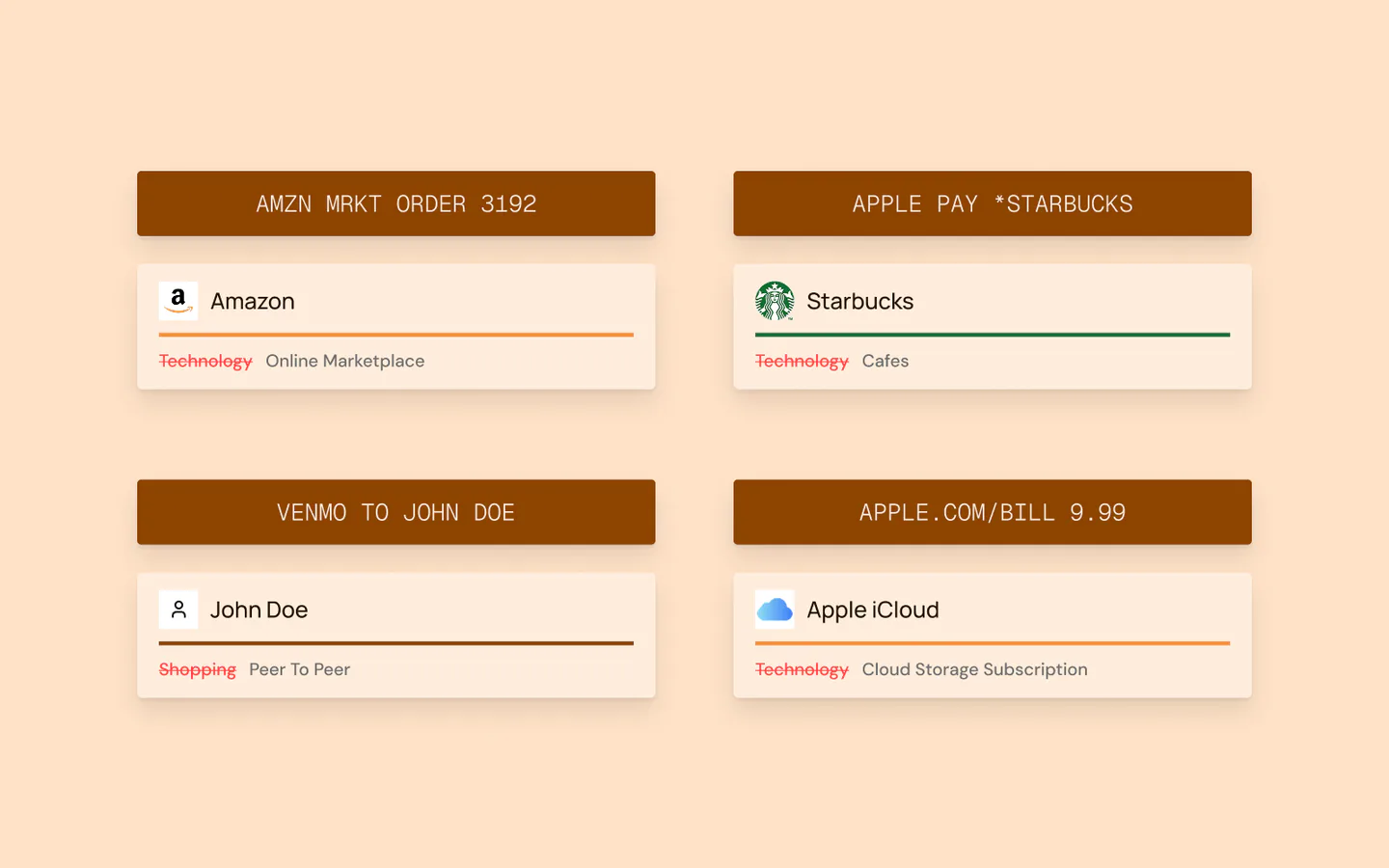
Digital wallets and payment aggregators create a layer of abstraction that obscures the actual merchant. When a transaction appears as APPLE PAY *SQUAREUP or PAYPAL *MERCHANT, the categorization system must determine not just who the intermediary is, but who the user actually paid through that intermediary. Without this separation, wallet transactions end up miscategorized as "technology" or "financial services."
Subscriptions appear identical month after month from a formatting perspective, but their categories vary enormously. A 9.99 dollar monthly charge could be music streaming (entertainment), cloud storage (technology), news (media), fitness (health), or software tools (business). The amount and recurrence pattern provide no category signal. Only the merchant identity does.
Peer-to-peer transfers through platforms like Venmo, Zelle, or PayPal look like expenses in the bank feed but are actually money movements, not consumption. Categorizing a Venmo transfer as "shopping" or "services" because Venmo is classified as a financial services company is misleading.
International transactions compound every other problem. Non-Latin character sets, local abbreviations, regional payment processors, and country-specific formatting conventions all reduce the effectiveness of categorization models trained primarily on English-language, North American or European data.
Why Rule-Based Categorization Fails at Scale
The most intuitive approach to categorization is building rules: if the transaction contains "STARBUCKS," categorize it as "Coffee and Cafes." If it contains "UBER," categorize it as "Transportation." This approach works surprisingly well for a prototype or a product with a narrow user base in a single market.
But rule-based systems fail predictably as they scale. The number of rules grows linearly with the number of merchants and transaction formats your system must handle. Maintaining thousands of rules across multiple markets becomes a full-time job for a data team. Rules are brittle. A single character change in a bank's formatting can break a match. Rules cannot handle ambiguity. They cannot distinguish between "UBER" the ride service and "UBER EATS" the food delivery platform when both appear as "UBER" in the descriptor. Rules cannot reason about context, so they cannot use amount patterns, recurrence, location, or channel to improve categorization accuracy.
To illustrate how quickly rules break, consider this simplified categorization function:
function categorize(description) { if (description.includes("STARBUCKS")) return "Coffee and Cafes"; if (description.includes("UBER")) return "Transportation"; // But "UBER EATS" is food delivery, not transportation // And "SBX*STARBUCKS" won't match "STARBUCKS" return "Uncategorized";}The UBER rule incorrectly categorizes Uber Eats as "Transportation," and the STARBUCKS rule misses any variant that uses the abbreviation SBX. An enrichment API handles both correctly because it resolves the merchant identity first, then maps to a category.
The fundamental problem is that rule-based systems treat categorization as a deterministic lookup problem when it is actually a probabilistic inference problem. No finite set of rules can cover the infinite variety of real-world transaction data.
How Transaction Enrichment APIs Solve the Categorization Problem
The most effective way to improve categorization is not to build better categorization rules. It is to build better upstream enrichment that resolves ambiguity before categorization even runs.
When a transaction enrichment API processes a raw transaction, it produces structured data that makes categorization dramatically simpler. Instead of trying to categorize the cryptic string SQ *VERVE COFFEE ROASTERS SAN FRANCISCO, a categorization system receives a clean merchant name ("Verve Coffee Roasters"), a merchant type ("Coffee Shop"), a payment channel ("in-store"), a location ("San Francisco, CA"), the intermediary ("Square"), and a confidence score.
With this enriched context, categorization becomes a straightforward mapping from a known merchant type to a spending category. Compare the raw input to what the enrichment API actually returns:
{ "input": "SQ *VERVE COFFEE ROASTERS SAN FRANCISCO", "enrichment": { "merchant": { "name": "Verve Coffee Roasters", "type": "Coffee Shop" }, "category": { "primary": "Food and Drink", "secondary": "Coffee and Cafes", "tertiary": "Coffee Shop" }, "intermediary": { "name": "Square", "type": "payment_facilitator" }, "location": { "city": "San Francisco", "state": "CA" }, "channel": "in_store", "confidence": 0.95 }}The hard work of identifying the merchant, resolving the intermediary, and extracting context has already been done by the enrichment layer.
This is why leading fintech products invest in strong enrichment rather than complex categorization logic. Better enrichment inputs produce better categorization outputs with simpler, more maintainable code.
What Developers Should Look for in a Categorization API
When evaluating a transaction categorization API, whether as a standalone service or as part of a broader enrichment API, several capabilities distinguish effective solutions from basic ones.
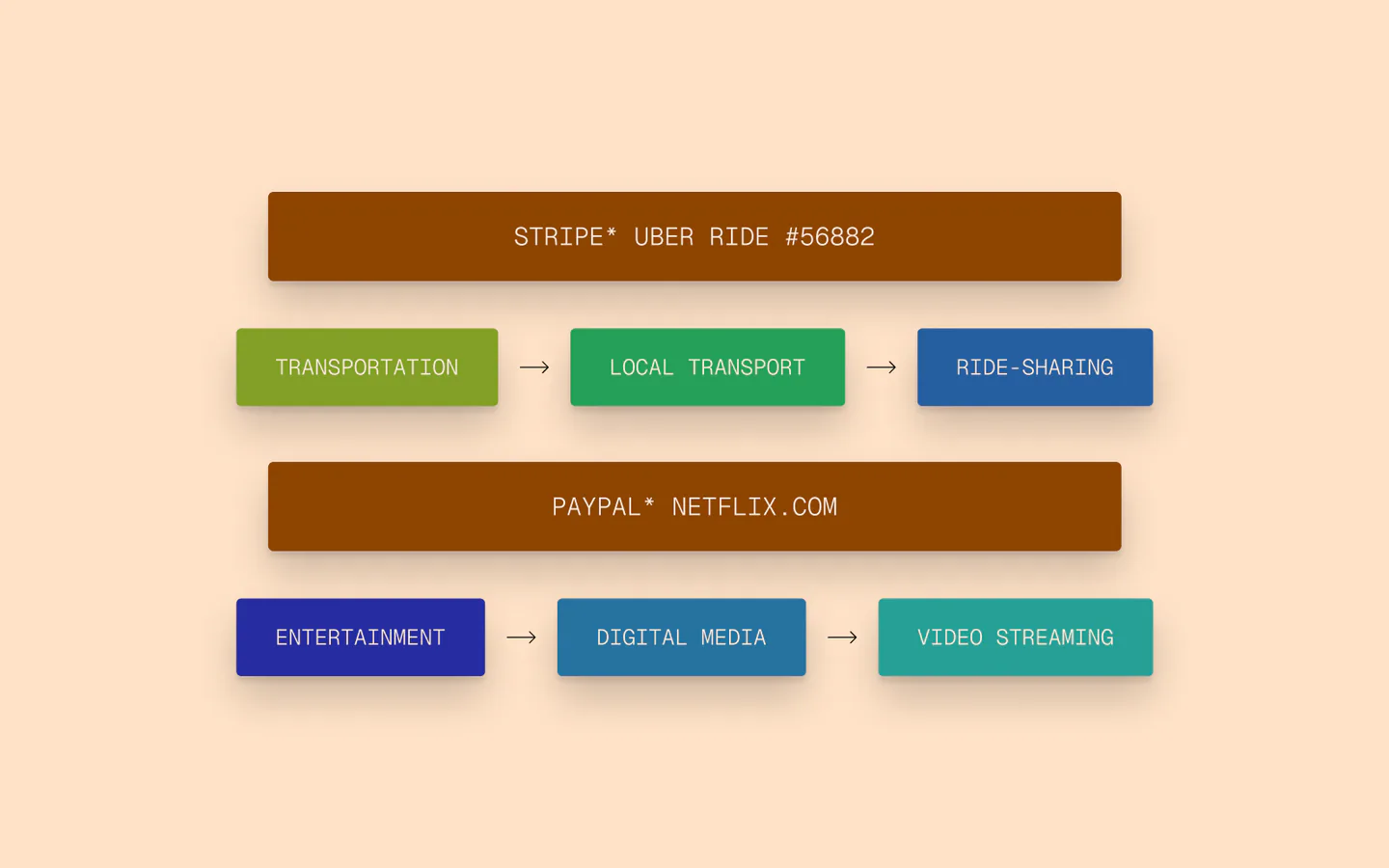
Hierarchical category depth matters because spending categories are inherently multi-level. A top-level "Food and Drink" category is useful for high-level budgeting, but users and business analytics often need granularity: "Restaurants" versus "Groceries" versus "Coffee and Cafes" versus "Fast Food." The best categorization systems support multiple category levels so your product can present the right level of detail for each context. Triqai's categorization engine supports three-level hierarchical categories across 121 distinct categories.
Separate treatment of income and expense categories is essential because the same merchant or transaction type may represent income for one user and an expense for another. Payroll, investment returns, rental income, and freelance payments all require different category logic than consumer spending. Triqai distinguishes 38 income categories from 69 expense categories, ensuring that both sides of a user's financial picture are accurately classified.
Confidence scoring for categories is just as important as confidence scoring for merchant identification. A transaction that could reasonably belong in two or three categories should indicate that uncertainty rather than arbitrarily picking one. Your application can then decide whether to display the best guess, show multiple options, or ask the user.
Context-aware categorization that considers the full enrichment context (merchant type, payment channel, location, recurrence pattern) rather than relying on a single signal produces meaningfully better results. A charge at "Apple" from the App Store (online, digital goods) should categorize differently than a charge at "Apple" in a retail location (electronics, hardware).
How Triqai Handles Transaction Categorization
Triqai's categorization is integrated directly into the enrichment pipeline rather than operating as a separate step. When a transaction is enriched through Triqai's API, the categorization system has access to the full enrichment context: the resolved merchant identity, the payment channel, the location, the intermediary, and any recurrence signals.
Because Triqai uses AI reasoning and web-derived context to identify merchants dynamically rather than relying on a fixed dataset, the categorization system receives richer, more accurate merchant data as input. This produces 95%+ categorization accuracy because the system is categorizing well-identified merchants rather than trying to infer categories from raw text or forcing matches against a limited merchant list. The 121-category taxonomy spans three hierarchical levels, giving developers flexibility to display broad categories for budgeting overviews and granular sub-categories for detailed spending analysis.
Triqai also identifies the payment channel as in-store, online, mobile app, ATM, or bank transfer. These signals feed into categorization to improve accuracy for transactions that would otherwise be ambiguous.
For developers, the categorization arrives as part of the standard enrichment response. There is no separate API call, no additional configuration, and no need to build custom categorization logic on top of the enrichment output. The category hierarchy is immediately usable for building budgeting interfaces, spending analytics, financial reports, and personalized insights.
Best Practices for Production Transaction Categorization
Instead of chasing perfect categorization accuracy (which is structurally impossible given the ambiguity of financial data), product teams should optimize for consistency, transparency, and continuous improvement.
Prioritize consistency over cleverness. Users adapt to predictable categorization even when it is occasionally wrong. Inconsistent categorization where the same type of transaction appears in different categories on different days is far more damaging to trust than consistent, slightly imperfect categorization.
Surface confidence scores and design fallback behavior. When the system is uncertain about a category, communicate that honestly rather than displaying a potentially wrong category with false certainty:
function displayCategory(enrichment, rawDescription) { const { category, confidence } = enrichment; if (confidence >= 0.85) return category.secondary || category.primary; if (confidence >= 0.6) return category.primary; // broader category is safer return "Uncategorized"; // let the user decide}Consider showing the raw merchant name without a category, or offering the user a choice between the two most likely options.
Support user corrections and respect them permanently. Allow users to recategorize transactions, and ensure those corrections persist through re-enrichment cycles. Over time, user corrections become a valuable signal for evaluating and improving categorization quality across your entire user base.
Separate enrichment from categorization conceptually even if your API provider handles both. Understanding that categorization quality depends on enrichment quality helps you diagnose issues correctly. If categories are wrong, the root cause is usually poor merchant identification rather than a categorization model problem.
Invest in re-enrichment rather than rule patches. When you notice a pattern of miscategorized transactions, the solution is usually better enrichment of the underlying merchant, not a custom categorization rule that handles one edge case and potentially breaks others.
Conclusion
Transaction categorization is hard because it sits at the intersection of ambiguous data, human intent, and imperfect signals. MCC codes are too coarse. Rule-based systems are too brittle. And raw bank transaction data simply does not contain enough information for reliable categorization on its own.
The solution is not more complex categorization logic. It is better upstream enrichment. When a transaction enrichment API resolves the merchant identity, detects the payment channel, identifies the location, and adds structured context before categorization runs, the categorization problem transforms from probabilistic guessing into straightforward mapping. For teams weighing whether to build this capability themselves or integrate an existing solution, our build vs. buy analysis breaks down the real costs and timelines.
Modern enrichment APIs like Triqai deliver this by combining AI reasoning and web-derived context with hierarchical categorization across 121 categories, achieving 95%+ accuracy on identified transactions. Rather than relying on a fixed merchant dataset, Triqai dynamically identifies merchants using web data and contextual signals, which means categorization works reliably even for merchants that no static database would cover. For fintech teams building products that depend on accurate spending data, integrating a proven enrichment API is the fastest and most reliable path to categorization that users actually trust. For a practical guide to implementing categorization effectively, read our best practices for automated transaction categorization. Get started for free and test the difference on your own transaction data.
Frequently asked questions
Tags
Related articles

Written by
Wes Dieleman
Founder & CEO at Triqai
December 23, 2025
Wes founded Triqai to make transaction enrichment accessible to every developer and fintech team. With a background in software engineering and financial data systems, he leads Triqai's product vision, AI enrichment research, and API architecture. He writes about transaction data, merchant identification, and building developer-first fintech infrastructure.