AI Transaction Enrichment: How Intelligent APIs Achieve Global Accuracy Without Massive Datasets

Transaction enrichment sits at the foundation of nearly every modern financial product. From personal finance apps to enterprise risk systems, from neobanks to lending platforms, enriched transactions are what turn raw bank data into something humans can understand and machines can analyze. Without enrichment, financial products are built on a foundation of cryptic strings and missing context.
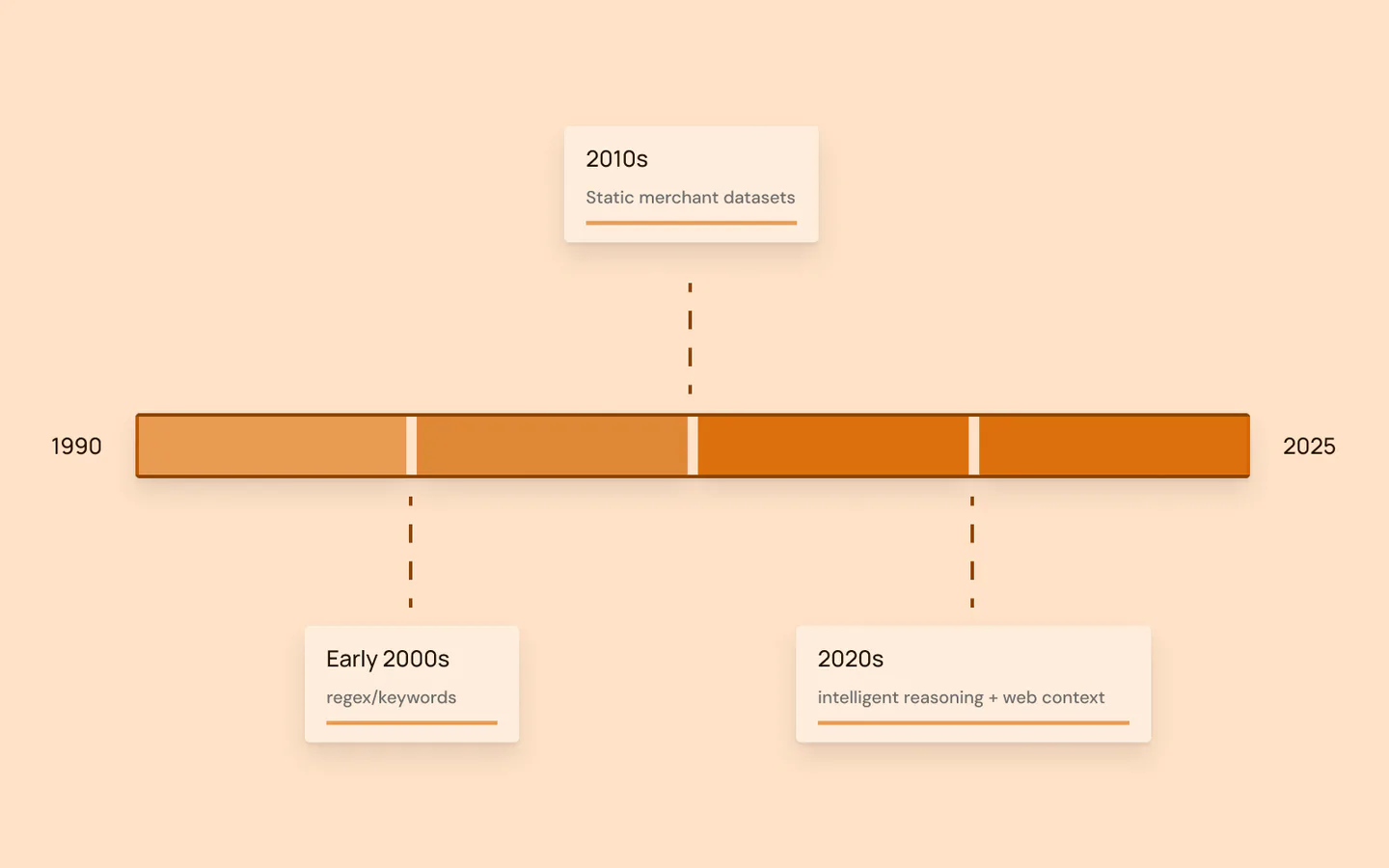
Yet the way enrichment works today looks fundamentally different from how it began. The industry has progressed through distinct technological eras, from handcrafted rules to static merchant databases to AI-powered reasoning systems, each driven by the limitations of the previous approach. Understanding this evolution is not just history. It reveals why the current generation of AI transaction enrichment systems exists, what problems they solve that earlier approaches could not, and what to look for when choosing a transaction enrichment API for your product.
The Rules Era: Where Transaction Enrichment Started
The earliest phase of transaction enrichment was defined by necessity. Banks and the first generation of fintech products received transaction data as short, inconsistent text strings with no standardization, no shared merchant identifiers, and minimal contextual information. The only way to make sense of this data was to build logic by hand.
Teams wrote regular expressions to extract fragments from transaction descriptions. They maintained hard-coded keyword lists to map known merchant strings to spending categories. They built string-matching pipelines to identify common payees. This rule-based approach was deterministic, fast, and perfectly adequate for a narrow scope: a small number of banks, a single geography, and predictable transaction formats.
But rule-based enrichment was fragile by design. A typical rule-based enrichment system looked something like this:
RULES = { "STARBUCKS": {"name": "Starbucks", "category": "Coffee"}, "AMAZON": {"name": "Amazon", "category": "Shopping"}, "UBER": {"name": "Uber", "category": "Transportation"},}def enrich(description): for keyword, result in RULES.items(): if keyword in description.upper(): return result return {"name": description, "category": "Unknown"}# Works: enrich("STARBUCKS #12345 SEATTLE")# Fails: enrich("SBX*STARBUCKS MOBILE ORDER") -> Unknown# Wrong: enrich("UBER EATS DELIVERY") -> TransportationEvery new bank format required new rules. Every merchant name change, every spelling variation, every abbreviation required manual updates. International expansion was nearly impossible because rules written for English-language, US-format descriptors broke immediately when confronted with German, Japanese, or Arabic text.
The fundamental limitation was that rule-based systems treated enrichment as a lookup problem: find the string, return the result. When the string did not match anything in the ruleset, the system returned nothing useful. There was no ability to reason, infer, or adapt.
The Database Era: Scaling With Static Merchant Data
As fintech products grew beyond single markets, rules alone were no longer viable. The industry's response was to build and buy structured merchant datasets: large databases mapping merchant names, aliases, and identifiers to clean brand names, categories, and metadata.
These dataset-driven systems represented a major improvement. Merchant recognition became more consistent because the same database served all transactions. Coverage expanded as database vendors added more merchants. Categories became more standardized. Major global brands were identified reliably across most transaction formats.
However, static merchant databases introduced their own set of constraints that became increasingly problematic at scale.
Database maintenance was expensive and never complete. The merchant landscape changes constantly. In the United States alone, approximately five million new businesses are registered every year, and countless existing businesses rebrand, relocate, or close. No fixed dataset keeps up with this rate of change. Coverage inevitably lagged reality, particularly for small businesses, new startups, and merchants in emerging markets.
Geographic coverage was deeply uneven. Dataset vendors concentrated their efforts on North American and Western European markets where the commercial demand was highest. Merchants in Southeast Asia, Latin America, Africa, the Middle East, and Eastern Europe were dramatically underrepresented. For any fintech product with global ambitions, this meant enrichment quality varied enormously by geography.
The long-tail problem was structural. Payment industry analysis consistently shows that a small number of major merchants drive a disproportionate share of all consumer transactions. The top 500 or so account for roughly half of transaction volume, while the remaining half is distributed among millions of smaller, regional, and local merchants. A fixed dataset covering the top 500 merchants achieves approximately 50% recognition, adequate for a demo but inadequate for a production product. Reaching 75% or higher recognition requires handling the long tail, which is exactly where fixed datasets are weakest.
New payment methods broke database assumptions. Digital wallets, payment facilitators like Square and Stripe, marketplace platforms, and peer-to-peer payment apps all introduced new descriptor formats that static databases were not built to handle. A database entry for "STARBUCKS" does not help when the transaction appears as APPLE PAY *SQ *STARBUCKS.
Why Static Datasets Cannot Keep Up With Modern Payments
The structural limitations of database-driven enrichment have become more acute as the financial ecosystem evolves. Several converging trends have made static approaches increasingly insufficient.
The rapid proliferation of digital-first businesses means new merchants appear constantly without the physical footprint or established web presence that database vendors use to discover and catalog them. A new direct-to-consumer brand, a pop-up restaurant, a local service provider accepting payments through a mobile terminal: these businesses exist and process real transactions long before any merchant database knows about them.
Payment intermediaries have multiplied. Square, Stripe, Adyen, Toast, Clover, SumUp, and dozens of other payment facilitators sit between the merchant and the bank. Each one reformats the transaction descriptor in its own way, often replacing the merchant name with the facilitator's name. Database-driven enrichment that relies on merchant name matching cannot reliably handle this intermediary layer.
Cross-border commerce is now routine. A consumer in Germany buying from a Korean merchant through a US marketplace, paying with a Dutch bank card via Google Pay, generates a transaction that no single-geography database can resolve. The descriptor might combine English, Korean, and Dutch text with multiple currency references and a payment facilitator identifier from yet another country.
Real-time commerce creates constant churn in the merchant landscape. Pop-up shops, seasonal businesses, event vendors, and gig economy services come and go faster than any manual database curation process can track. By the time a new merchant is added to a database, it may already have closed.
How AI Reasoning Transforms Transaction Enrichment
The shift from database-driven to AI-powered enrichment represents the most significant architectural change in the history of transaction enrichment. Instead of asking "Is this merchant in my database?", AI transaction enrichment systems ask broader, more powerful questions: What does this transaction likely represent? What signals do the text, amount, channel, and context provide? What do we know about this entity from the wider digital ecosystem?
AI enrichment focuses on inference and reasoning rather than lookup and matching. These systems can interpret unfamiliar merchants, process ambiguous descriptions, handle non-Latin scripts, and adapt to evolving transaction patterns without requiring that every merchant be pre-cataloged in a database.
This approach works because modern AI systems, including large language models, neural networks, and specialized embedding models, are exceptionally good at understanding natural language, recognizing patterns across diverse data, and making probabilistic inferences from partial information. A transaction descriptor like BAR CELONA TAPAS AMSTERDAM NL contains enough signal for an AI system to infer that this is likely a Spanish-themed restaurant in Amsterdam called "Barcelona Tapas" even if no merchant database contains this specific entry.
Critically, AI enrichment does not mean guessing blindly. Reasoning-based systems combine multiple weak signals into a coherent understanding, weighting each signal by its reliability and assigning confidence scores that reflect genuine uncertainty. A strong signal (an exact match with a known merchant) produces high confidence. Weak signals (a partial name match combined with a plausible amount and location) produce moderate confidence. Insufficient signals produce low confidence with an honest indication that the system is uncertain.
The result is that AI-powered enrichment outperforms database-driven enrichment precisely where databases are weakest: the long tail of small merchants, international transactions, new businesses, and payment intermediary chains.
What Makes Intelligent Transaction Enrichment Different
Several capabilities distinguish modern AI transaction enrichment from its predecessors, and understanding these differences helps developers evaluate which approach their product needs.
Web-derived context is perhaps the most transformative capability. Instead of relying on a fixed merchant dataset, AI enrichment systems draw on the broader digital ecosystem in real time: business directories, map services, review platforms, social media profiles, delivery app listings, and corporate websites. This means that a small coffee roaster in Portland that has a Google Maps listing, an Instagram profile, and a Yelp page can be identified dynamically, without needing to be pre-cataloged in any dataset. The merchant's digital footprint becomes the data source, and the system can handle millions of merchants and entities without maintaining a static list.
Multilingual and multi-script processing allows AI systems to handle transactions in any language without requiring separate datasets for each. Japanese kanji, Korean hangul, Arabic script, Cyrillic characters, and Devanagari text can all be processed by the same model. This is a fundamental advantage over dataset-driven systems that must maintain separate, manually curated merchant lists for each language and region.
Intermediary separation enables the system to identify each layer of a complex payment chain. When a transaction passes through Apple Pay, processed by Square, for a local bakery, an AI system can identify all three entities and their roles: Apple Pay as the wallet, Square as the payment facilitator, and the bakery as the merchant. Each entity receives its own name, logo, and metadata. Database-driven systems that treat the descriptor as a single entity typically identify only the most prominent name, usually the intermediary, not the merchant.
Continuous learning from new transaction patterns means the system improves over time without manual database updates. As the AI processes transactions from new merchants, new regions, and new payment methods, its models incorporate those patterns and become more accurate. This is fundamentally different from database-driven enrichment, where coverage only improves when someone manually adds new entries.
Confidence scoring calibrated to actual reliability gives downstream systems the information they need to make intelligent decisions. Rather than returning a binary "matched/not matched" result, AI enrichment provides nuanced confidence scores that reflect how certain the system is about each element of the enrichment.
| Capability | Rule-based | Database-driven | AI-powered |
|---|---|---|---|
| Long-tail merchant coverage | Very low, only manually added merchants | Low to medium, limited to database entries | High, identifies merchants via web context |
| Multilingual support | None, rules are language-specific | Limited, requires separate databases per language | Native, processes any script or language |
| Intermediary handling | None, treats descriptor as one entity | Minimal, often returns the processor not the merchant | Separates wallet, processor, and merchant |
| Adaptation speed | Manual, days to weeks per new pattern | Manual, depends on database vendor update cycles | Automatic, learns from new transaction patterns |
| Global scalability | Very low, rules per country required | Medium, uneven geographic coverage | High, uses digital footprints worldwide |
How AI Enrichment Achieves Global Accuracy
Global transaction enrichment has historically been one of the hardest problems in fintech infrastructure. Different countries have different banking systems, different languages, different payment conventions, and dramatically different merchant landscapes. For banks serving international customers, this challenge is compounded by regulatory requirements like PSD3 that demand consistent data quality across open banking APIs, as we cover in our guide on transaction enrichment for banks. Database-driven enrichment that works well in the United States typically underperforms in South America, Southeast Asia, or Africa because the databases lack coverage in those regions.
AI-powered enrichment achieves global accuracy through a fundamentally different mechanism. Instead of requiring a pre-built dataset for every country, AI systems leverage the digital footprint that businesses leave across the web. Even in countries with limited traditional banking infrastructure, merchants have Google Maps listings, Facebook pages, WhatsApp business profiles, and local directory entries. AI enrichment systems can discover and use this information in real time to identify merchants regardless of whether they appear in any structured dataset.
This approach has several advantages for fintech products with global ambitions. It eliminates the cold-start problem for new geographies because you do not need to wait for a dataset vendor to build coverage in a new country before your enrichment works there. It handles regional payment methods (PIX in Brazil, UPI in India, iDEAL in the Netherlands, SEPA across Europe) because the AI models understand these payment systems and their descriptor formats. It processes local languages natively without translation, maintaining the accuracy that comes from understanding the original text. And it improves organically as more businesses create digital presences, without requiring manual curation.
Triqai's enrichment engine embodies this approach. Built on AI reasoning supplemented by real-time web context, Triqai is not constrained by a fixed merchant list. Instead of maintaining a static dataset that inevitably falls behind, Triqai dynamically identifies merchants by reasoning about transaction context and cross-referencing web data, meaning it can handle millions of merchants and entities without needing them pre-cataloged. The system processes transactions in local languages including non-Latin scripts, detects payment processors and intermediaries, and categorizes transactions into 121 distinct categories with 95%+ accuracy. Its strongest coverage spans Europe, the US, the UK, and ANZ while supporting all countries globally.
The Build vs Buy Decision for AI Transaction Enrichment
For fintech teams evaluating their enrichment strategy, the rise of AI enrichment changes the build-versus-buy calculus significantly.
Building rule-based or database-driven enrichment in-house was already challenging but conceptually straightforward: collect merchant data, build matching logic, maintain the database. Building AI-powered enrichment in-house requires a fundamentally different set of capabilities: machine learning engineering expertise, access to diverse training data across geographies and transaction types, infrastructure for running AI models at production scale, web crawling and data aggregation pipelines, and ongoing model evaluation and refinement.
The investment required is substantial. Industry estimates suggest that building production-quality AI enrichment from scratch requires twelve or more months of development time, a specialized team of ML engineers and data scientists, and hundreds of thousands of dollars in infrastructure and data costs, all before achieving the accuracy that a specialized transaction enrichment API provides from day one.
Moreover, AI enrichment benefits enormously from network effects. Every customer that uses the system generates transaction patterns that improve the models for all customers. A standalone in-house system, no matter how well built, cannot access this collective intelligence.
For these reasons, even fintech companies with strong engineering teams increasingly choose to use specialized enrichment APIs rather than building in-house. The API approach provides immediate access to state-of-the-art AI enrichment, eliminates the need for ML infrastructure and expertise, benefits from continuous improvement driven by the provider's full customer base, and frees engineering resources to focus on building product features rather than data infrastructure. For a comprehensive cost breakdown and decision framework, see our full guide on build vs. buy for transaction enrichment.
| Metric | In-house build | API integration |
|---|---|---|
| Time to launch | 12+ months | Days |
| Cost model | High upfront cost | Pay-per-use |
| Accuracy trajectory | Slow accuracy growth | Immediate high accuracy |
| Maintenance burden | Ongoing maintenance | Zero maintenance |
How Triqai Uses AI for Transaction Enrichment
Triqai represents the current generation of AI-powered transaction enrichment. Several architectural choices distinguish it from both legacy database systems and generic AI approaches.
Triqai combines purpose-built AI models with real-time web context rather than relying on a fixed dataset. The AI models handle pattern recognition, natural language understanding, and contextual reasoning, while web-derived data provides fresh, dynamic information about merchants, locations, and businesses. This means Triqai stays current without manual dataset updates and can identify merchants that no static system would cover.
The enrichment pipeline processes transactions through merchant identification, hierarchical categorization across three levels, location enrichment with store-level precision across 150+ countries, intermediary detection and separation across the full payment chain, and confidence scoring that reflects genuine certainty. Because the system reasons about each transaction with full context before returning a result, it avoids the false positives that fixed-dataset systems produce when they force a match against a limited merchant list.
Triqai's integration is designed for simplicity despite the complexity happening behind the scenes. With the official Node.js SDK, enrichment is a single method call with full TypeScript support and automatic retries:
import Triqai from "triqai";const triqai = new Triqai("triq_your_api_key");const result = await triqai.transactions.enrich({ title: "BAR CELONA TAPAS AMSTERDAM NL", country: "NL", type: "expense",});Or use the REST API directly with a single POST request:
curl -X POST https://api.triqai.com/v1/transactions/enrich \ -H "Authorization: Bearer YOUR_API_KEY" \ -H "Content-Type: application/json" \ -d '{ "title": "BAR CELONA TAPAS AMSTERDAM NL", "country": "NL", "type": "expense" }'Even for a merchant that does not appear in any traditional database, the AI returns a structured result:
{ "merchant": { "name": "Barcelona Tapas", "logo": "https://logos.triqai.com/images/barcelona-tapascom" }, "category": { "primary": "Food and Drink", "secondary": "Restaurants", "tertiary": "Spanish Restaurant" }, "location": { "city": "Amsterdam", "country": "NL", "formatted": "Amsterdam, Netherlands" }, "confidence": 0.87}There is no batch file processing, no complex configuration, and no required preprocessing. For JavaScript and Node.js developers, the official SDK (npm install triqai) provides full TypeScript support, automatic retries, and auto-pagination out of the box. Developers can test the API immediately with a free tier of 100 enrichments per month and integrate it into production systems within days.
The system supports transactions from any source and any country, with strongest coverage in the EU, US, UK, and ANZ. Local languages are processed natively, including Japanese, Korean, Arabic, and Cyrillic scripts. Regional payment methods like PIX, UPI, iDEAL, and SEPA are specifically supported.
The Future of Transaction Enrichment
The trajectory of transaction enrichment points clearly toward AI-first architectures that reason about transactions rather than simply looking them up. Several trends will accelerate this shift.
Payment complexity will continue to increase. New wallet platforms, embedded finance, buy-now-pay-later services, cryptocurrency integrations, and cross-border payment networks all create new transaction types that static databases cannot anticipate. Only reasoning-based systems can adapt to payment methods that did not exist when the system was built.
Global fintech adoption will expand enrichment requirements to every market simultaneously. The era of building enrichment one country at a time is ending. Products launch globally from day one, and enrichment must work globally from day one as well.
Real-time financial products will demand real-time enrichment accuracy. Users expect instant, accurate transaction information in their banking apps, budgeting tools, and financial dashboards. Enrichment that is slow, inaccurate, or incomplete is no longer acceptable even for a small percentage of transactions.
Regulatory requirements around transaction transparency and categorization will increase, raising the stakes for enrichment accuracy. Financial institutions will need to demonstrate that their transaction data is consistently classified, which creates demand for auditable, confidence-scored enrichment rather than opaque matching.
Conclusion
Transaction enrichment has evolved from simple regex rules to static merchant databases to AI-powered reasoning systems, and each transition was driven by the fundamental limitations of the previous approach. Rules could not scale. Databases could not keep up. Only AI reasoning, combined with web-derived context, multilingual processing, intermediary separation, and honest confidence scoring, can meet the demands of modern global fintech products.
The current generation of AI transaction enrichment APIs, led by platforms like Triqai, delivers global accuracy by reasoning about transactions rather than looking them up in a fixed dataset. By combining AI with web-derived context, these systems handle the long tail of merchants, adapt to new payment methods, process any language, and improve continuously, all through a simple API that developers can integrate in days.
For fintech teams choosing their enrichment strategy today, the path forward is clear: AI-powered enrichment APIs are faster to integrate, more accurate globally, more adaptable to change, and more cost-effective to maintain than any in-house alternative. The question is no longer whether to adopt AI enrichment, but which provider delivers the best results on your specific transaction data. Start testing with Triqai for free — for Node.js projects, get started in minutes with npm install triqai — and see the difference on your own transactions.
Frequently asked questions
Tags
Related articles

Written by
Wes Dieleman
Founder & CEO at Triqai
December 21, 2025
Wes founded Triqai to make transaction enrichment accessible to every developer and fintech team. With a background in software engineering and financial data systems, he leads Triqai's product vision, AI enrichment research, and API architecture. He writes about transaction data, merchant identification, and building developer-first fintech infrastructure.