What Is Transaction Data Enrichment? How It Works and Why Fintechs Need It
Every fintech product that displays bank transactions to users faces the same foundational problem: raw transaction data is almost unusable. A user's bank feed contains entries like AMZN MKTP US*2R7HG1MQ3, SQ *BLUE BOTTLE COFFEE SF, or PAYPAL *AIRBNBHM 402935. These strings were designed for bank settlement systems, not for consumer applications. They carry no clean merchant name, no spending category, no logo, and no location that a user interface can display meaningfully.
Transaction data enrichment solves this by transforming raw banking strings into structured, actionable data. It is the process of taking a cryptic descriptor and returning a clean merchant name, an accurate spending category, a brand logo, a geographic location, and a confidence score, all through a single API call. For fintech teams, enrichment is the invisible infrastructure layer that makes budgeting tools, spending analytics, and fraud systems actually work.
This article explains what transaction data enrichment is, why raw bank data is fundamentally broken, how modern enrichment works, what use cases it enables, and how to evaluate enrichment solutions for your product.
Why Raw Bank Transaction Data Is Unusable
Understanding why enrichment is necessary starts with understanding why bank transaction data is so poor. The short answer is that transaction descriptors were never designed for human consumption.
When a payment is processed, it passes through multiple systems: the merchant's point-of-sale terminal, the acquiring bank, the card network, and the issuing bank. Each system adds, truncates, or reformats information along the way. The result is a descriptor string that is optimized for reconciliation between financial institutions, not for displaying to a consumer in a mobile banking app.
This creates several structural problems that no amount of simple text processing can fix.
Inconsistent formatting across banks. The same purchase at Starbucks might appear as STARBUCKS #12345 SEATTLE, SBX*STARBUCKS MOBILE, CARD PURCHASE STARBUCKS CORP, or POS DEBIT STARBUCKS COFFEE depending on which bank issued the card, which payment method was used, and which country the transaction occurred in. There is no universal formatting standard.
Truncation and abbreviation. Legacy banking systems impose character limits on descriptor fields, typically 20 to 25 characters. Merchant names, locations, and reference numbers are compressed into this limited space, often making them unrecognizable. A boutique hotel called "The Grand Pacific Resort & Spa" might appear as THE GRAND PAC RESORT.
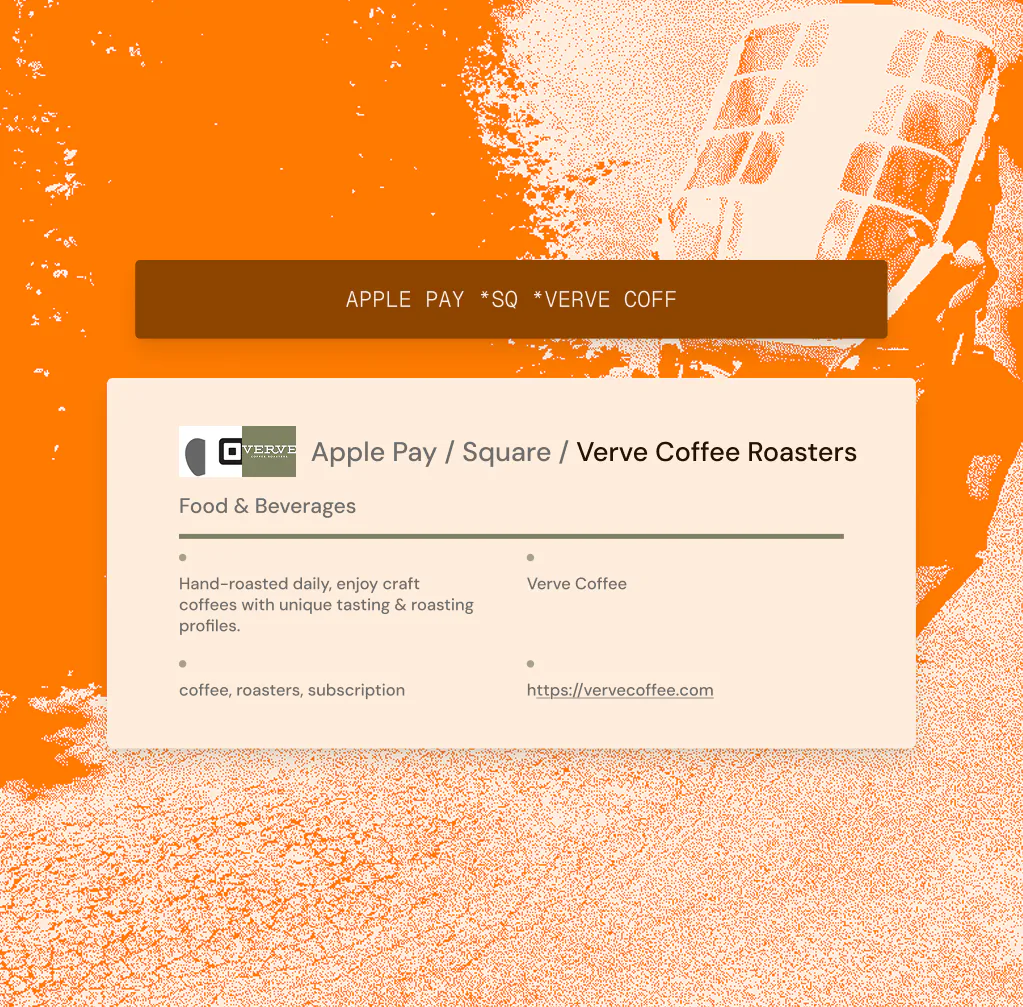
Payment intermediary injection. Digital wallets like Apple Pay and Google Pay, and payment facilitators like Square, Stripe, and PayPal, insert their own identifiers into the descriptor string. A coffee purchase through Square becomes SQ *VERVE COFFEE ROASTERS where the actual merchant name shares space with the processor prefix. As we detail in our guide on why wallet transactions are harder to enrich, this intermediary layer adds significant complexity to merchant identification.
No universal merchant identifier. Unlike domains on the internet, there is no global registry of merchant identities that banks reference. The same merchant can appear under different names, different MCC codes, and different descriptor formats across banks and payment networks.
These are not temporary problems that will be fixed by modernizing banking infrastructure. They are structural artifacts of a decentralized global payment system built over decades by thousands of independent institutions. Any fintech product that wants to display meaningful transaction information to users must invest in enrichment.
How Transaction Data Enrichment Works
Modern transaction data enrichment is a multi-stage pipeline that progressively transforms raw text into structured data. Each stage builds on the output of the previous one, and accuracy at every stage compounds to determine the quality of the final result.
Stage 1: Normalization. The raw descriptor is cleaned by removing noise tokens, standardizing character encoding, normalizing separators and whitespace, and converting to a consistent format. This addresses surface-level inconsistencies like extra spaces, special characters, and bank-specific prefixes.
Stage 2: Parsing. The normalized string is analyzed to extract potential components: merchant name fragments, location indicators, payment processor identifiers, reference numbers, and date artifacts. The system separates signal from noise, identifying which parts of the string carry meaningful information.
Stage 3: Merchant resolution. This is the most complex and valuable stage. Parsed fragments are matched against real-world merchant entities using a combination of techniques. Basic systems use static databases of known merchants. Advanced systems like Triqai's enrichment engine use AI reasoning combined with real-time web context to identify merchants dynamically, handling new, small, and regional businesses that no fixed database would cover.
Stage 4: Categorization. Once the merchant is identified, the transaction is classified into a spending category. Effective categorization systems support hierarchical categories with primary, secondary, and tertiary levels, and distinguish between income and expense transactions. As our analysis of why transaction categorization is hard explains, this step requires merchant identity as input to be accurate, which is why enrichment must precede categorization.
Stage 5: Metadata enrichment. Additional context is attached: merchant logos, brand colors, website URLs, geographic location data including coordinates and structured addresses, and payment channel identification (in-store, online, mobile).
Stage 6: Confidence scoring. The API assigns a confidence score reflecting how reliable the enrichment is. High confidence means the system is very certain about the merchant identity. Low confidence signals ambiguity, allowing your application to decide whether to display enriched data or fall back to the raw descriptor.
The entire pipeline runs in real time. A single API call sends the raw descriptor and receives the full enrichment response:
{ "input": "SQ *BLUE BOTTLE COFFEE SF", "enrichment": { "merchant": { "name": "Blue Bottle Coffee", "logo": "https://logos.triqai.com/images/bluebottlecoffeecom", "website": "https://bluebottlecoffee.com" }, "category": { "primary": "Food and Drink", "secondary": "Coffee and Cafes", "tertiary": "Coffee Shop" }, "location": { "city": "San Francisco", "state": "CA", "country": "US" }, "intermediary": { "name": "Square", "type": "payment_facilitator" }, "channel": "in_store", "confidence": 0.95 }}What previously required building and maintaining separate systems for merchant matching, categorization, location resolution, and intermediary detection is now a single HTTP request.
What Transaction Data Enrichment Returns
The depth and quality of enrichment responses vary significantly between providers. Understanding what a comprehensive response includes helps you evaluate whether a provider meets your product's needs.
Merchant identity is the core output. This includes the clean, standardized merchant name, a unique merchant identifier for deduplication across transactions, the merchant's logo URL and brand colors for UI display, and the merchant's website. Strong providers like Triqai can identify millions of merchants dynamically using AI reasoning and web context, not just the top few thousand that appear in static databases.
Spending categories classify the transaction into a hierarchical taxonomy. The best systems provide three levels of depth. A purchase at a burger restaurant might be categorized as "Food and Drink" (primary), "Restaurants" (secondary), "Fast Food" (tertiary). Triqai supports 121 distinct categories spanning 69 expense categories and 38 income categories, giving developers the flexibility to show broad categories for budget overviews and granular sub-categories for detailed analysis.
Geographic location data provides structured address components (city, state, country), geographic coordinates for map display, timezone information, and formatted address strings. Store-level location enrichment across millions of places globally is what separates basic providers from comprehensive ones.
Payment context identifies how the transaction was made. This includes the payment channel (in-store, online, mobile app, ATM, bank transfer), and whether a payment intermediary was involved and who it was.
Confidence scoring accompanies every enrichment response. This is not a binary "found or not found" signal. It is a calibrated score that tells your application how certain the system is about the result. A transaction enriched with 97% confidence can be displayed as-is. A transaction at 55% confidence might warrant showing the raw descriptor alongside the enriched data, or allowing the user to confirm.
Real-World Use Cases for Transaction Data Enrichment
Transaction data enrichment is foundational infrastructure that powers a remarkably wide range of fintech features and products. Nearly every feature that touches bank transaction data depends on enrichment quality.
Personal Finance and Budgeting
Budgeting apps live or die by categorization accuracy. When a user sets a $200 monthly grocery budget, the app must correctly identify which transactions are groceries and which are not. A transaction at Target coded as "discount stores" might actually be a grocery run. A Costco purchase could be groceries, electronics, or household supplies. Without enrichment that goes beyond MCC codes to understand merchant context, budget tracking produces misleading results that erode user trust.
Enrichment also enables spending trend analysis, merchant-level spending breakdowns, and personalized financial insights. Showing a user that they spent $127 at Starbucks last month is only possible when all variants of Starbucks transactions (STARBUCKS, SBX*STARBUCKS, STARBUCKS MOBILE ORDER) are resolved to the same merchant entity.
Banking and Neobanking
Modern banking apps display transaction feeds with merchant logos, clean names, and spending categories. This polished experience is entirely dependent on enrichment. Without it, users see the same cryptic strings that appear on legacy bank statements, a direct contrast to the modern experience they expect.
Enrichment also powers spending insights (weekly or monthly spending summaries by category), and cashback or rewards programs that need to match transactions to merchant categories. Banks that implement comprehensive enrichment see measurable reductions in support calls and friendly fraud disputes. Our guide on transaction enrichment for banks covers the full business case.
Accounting and Expense Management
Business expense platforms use enrichment to automatically categorize expenses for tax reporting, match transactions to receipt data, generate accurate financial statements, and enforce spending policies. Manual transaction categorization is the single biggest time cost in expense management. Enrichment eliminates most of it.
Lending and Credit Assessment
Lenders analyze enriched transaction data to assess creditworthiness, verify income sources, understand spending patterns, and detect financial risk signals. Accurate categorization and merchant identification enable more precise lending decisions. An applicant who spends heavily on gambling versus one who spends on groceries and utilities presents a very different risk profile, but only if the categorization is accurate.
Fraud Detection and Compliance
Enrichment provides the geographic, merchant, and channel context that fraud detection models need. Identifying that a transaction occurred at a known high-risk merchant category, or in a geographic location inconsistent with the user's history, requires reliable enrichment upstream. Anti-money laundering monitoring similarly depends on accurate merchant identification and categorization.
Enrichment API vs. Building In-House
Fintech teams weighing whether to integrate an enrichment API or build the capability internally should understand the full scope of what building entails.
Building production-quality enrichment from scratch requires assembling and maintaining a merchant database with millions of entries, training ML models for merchant identification across diverse transaction formats, building categorization models with hierarchical taxonomy support, developing location extraction and resolution pipelines, creating intermediary detection logic for dozens of payment processors and wallets, and implementing calibrated confidence scoring. Realistic first-year costs range from $280,000 to $590,000, with first-year accuracy typically reaching only 60 to 75 percent. Our detailed build vs. buy analysis breaks down the full cost comparison and provides a decision framework.
An enrichment API eliminates this investment entirely. Integration takes hours to days, accuracy starts at 90%+ from day one due to cross-customer network effects, and maintenance is zero because the provider continuously improves their models. For most fintech teams, enrichment is critical infrastructure but not a competitive differentiator, making an API the better allocation of engineering resources.
How to Evaluate an Enrichment Provider
Not all enrichment APIs deliver the same quality. When evaluating providers, several criteria separate effective solutions from basic ones.
Test on your actual data. Published accuracy benchmarks are measured on curated datasets biased toward well-known merchants. Run your real production transactions through the API and measure the merchant recognition rate, categorization accuracy, and the percentage of transactions returned as unknown.
Evaluate geographic coverage. If your product serves international users, test how the API handles local banks, regional payment processors, non-Latin scripts (Japanese, Korean, Arabic), and local payment methods like PIX, UPI, or iDEAL. Many providers are optimized for North America and underperform elsewhere.
Examine response depth. A minimal provider returns a merchant name and category. A comprehensive provider returns hierarchical categories, logos, location data with coordinates, payment channel, intermediary detection, and confidence scores. The depth of the response determines which features you can build on top of it.
Verify privacy and compliance. Financial transaction data is sensitive. Confirm the provider is GDPR-compliant, does not retain raw transaction data beyond processing, and provides clear data handling documentation. Triqai processes data in the EU and enforces 90-day log retention with full GDPR compliance.
Check developer experience. The API should have clear documentation, official SDKs, typed responses, and sensible error handling. Triqai's Node.js SDK provides full TypeScript support, automatic retries with exponential backoff, and built-in error handling, reducing integration effort to a few lines of code.
Getting Started With Transaction Data Enrichment
Starting with enrichment is straightforward with a well-designed API. With Triqai, the integration is minimal. Using the Node.js SDK:
import Triqai from "triqai";const triqai = new Triqai(process.env.TRIQAI_API_KEY);const result = await triqai.transactions.enrich({ title: "AMZN MKTP US*2R7HG1MQ3 AMZN.COM/BILL WA", country: "US", type: "expense",});console.log(result.data);Or using the REST API directly:
curl -X POST https://api.triqai.com/v1/transactions/enrich \ -H "Authorization: Bearer YOUR_API_KEY" \ -H "Content-Type: application/json" \ -d '{ "title": "AMZN MKTP US*2R7HG1MQ3 AMZN.COM/BILL WA", "country": "US", "type": "expense" }'Triqai's free tier includes 100 enrichments per month, enough to build and test your integration without any upfront cost. Paid plans start at 21 euros per month for 4,000 enrichments with transparent per-transaction pricing at higher volumes.
For a hands-on look at what enrichment returns, try the interactive playground with your own transaction strings. For a deep dive into the full integration process with production best practices, follow our step-by-step integration guide. And for a comprehensive technical overview of what enrichment APIs deliver, read our complete guide to transaction enrichment for fintech developers.
Conclusion
Transaction data enrichment is the foundational infrastructure layer that transforms broken bank data into the structured information that powers every user-facing feature in a fintech product. Without enrichment, budgeting tools miscategorize spending, banking apps display cryptic strings instead of merchant names, and fraud systems lack the context they need to detect anomalies.
The underlying problem, that bank transaction data was designed for settlement and not for consumer applications, is structural and will not be solved by banking modernization alone. Enrichment APIs like Triqai address this by combining AI reasoning with real-time web context to identify merchants, categorize spending, resolve locations, and detect payment intermediaries, all through a single API call.
For fintech teams, the decision is not whether to invest in enrichment but how. Building in-house requires significant ML expertise, diverse training data, and ongoing maintenance. Integrating a proven API delivers higher accuracy from day one with zero infrastructure overhead. Start testing with Triqai's free tier and see how enrichment quality transforms your transaction data.
Frequently asked questions
Tags
Related articles

Written by
Wes Dieleman
Founder & CEO at Triqai
March 20, 2026
Wes founded Triqai to make transaction enrichment accessible to every developer and fintech team. With a background in software engineering and financial data systems, he leads Triqai's product vision, AI enrichment research, and API architecture. He writes about transaction data, merchant identification, and building developer-first fintech infrastructure.