Transaction Enrichment for Banks: How Financial Institutions Turn Raw Payment Data Into Clean Customer Intelligence
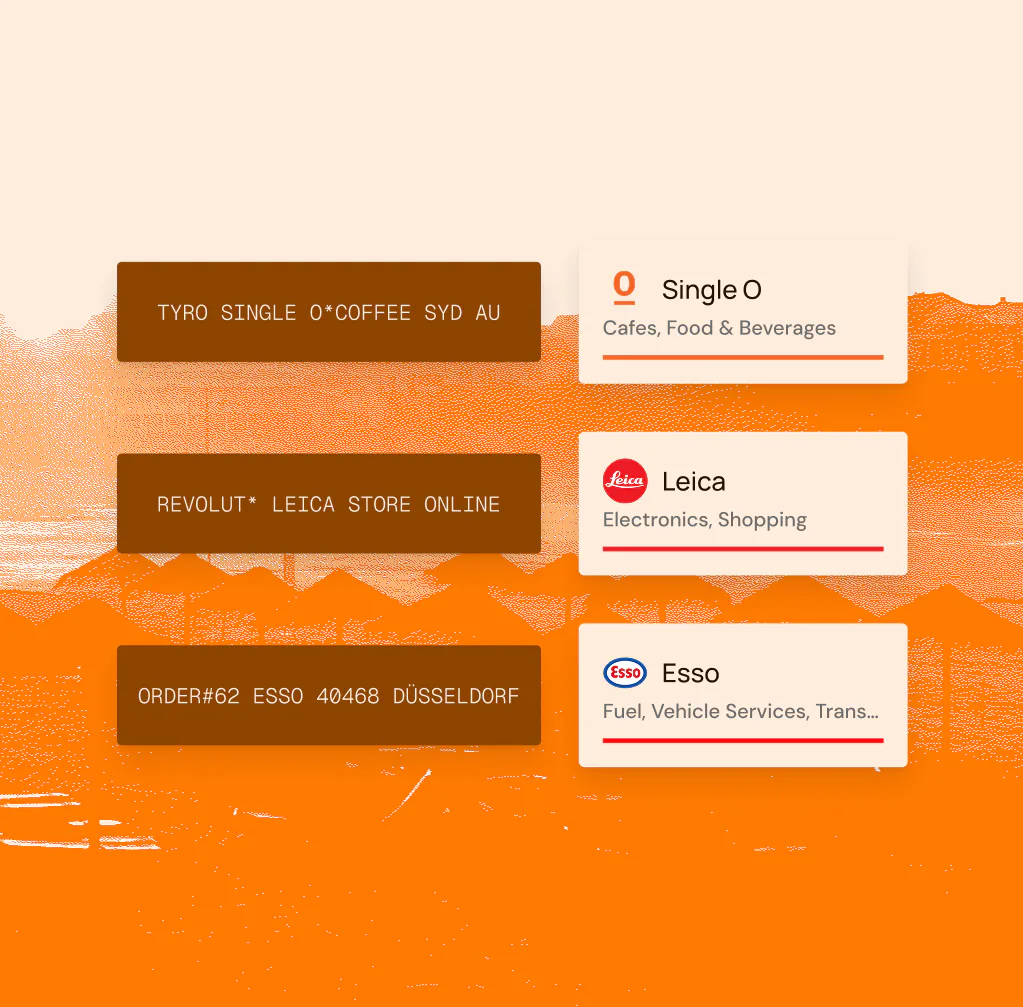
Banks hold one of the most valuable datasets in the world: transaction data. Every card swipe, bank transfer, direct debit, and digital wallet payment generates a record of economic activity. But in its raw form, this data is nearly unusable. A customer who bought coffee at a local cafe sees POS DEBIT SQ *BLUE BOTTLE COF in their banking app. A subscription to a streaming service appears as AMZN MKTP US*2R7HG1MQ3. A payroll deposit shows up as a cryptic reference number with no employer name attached.
This is the reality every bank faces: billions of transactions flowing through systems designed for settlement between financial institutions, not for serving customers. Transaction enrichment bridges this gap by transforming raw payment data into structured, human-readable information that powers every customer-facing feature in modern digital banking.
For financial institutions, the quality of enrichment data directly affects customer trust, support costs, chargeback rates, and the ability to deliver personalized products. Getting it wrong means displaying incorrect merchant names to millions of customers. Getting it right means turning every transaction into an opportunity to build confidence and deepen the banking relationship.
This article covers how banks use transaction enrichment to solve real business problems, why accuracy matters more than speed in a banking context, and how to evaluate enrichment solutions for financial institutions.
Why Raw Transaction Data Costs Banks Real Money
The transaction data that banks store was designed decades ago for interbank settlement. It was never intended to be displayed to customers or analyzed for behavioral insights. The cost of serving this broken data to customers is not theoretical. It shows up in support costs, chargebacks, and customer churn.
Chargebacks and Friendly Fraud
When customers cannot recognize a transaction on their statement, many assume the charge is fraudulent and file a dispute. This "friendly fraud" is one of the fastest-growing problems in banking and payments.
The numbers are significant. Unclear billing descriptors contribute to roughly 40% of all transaction disputes. Nearly 50% of consumers who could not recognize a purchase on their statement contacted their bank for clarification, and over 35% went further by requesting a refund directly from their bank. Friendly fraud now accounts for approximately 75% of all chargeback cases, and forecasts project a 40% rise in card disputes tied to friendly fraud by 2026.
For banks, each dispute triggers an investigation workflow that costs time, staffing, and money. The downstream cost of chargeback fraud is projected to reach $28.1 billion globally by 2026. Much of this is preventable: if customers could recognize their transactions in the first place, they would not dispute them.
Transaction enrichment addresses this at the source. When a bank displays "Blue Bottle Coffee, San Francisco" with a brand logo instead of POS DEBIT SQ *BLUE BOTTLE COF, the transaction becomes immediately recognizable. The customer sees what they bought, where they bought it, and confirms it was their purchase. No support call, no dispute, no chargeback.
Customer Support Volume
Transaction-related inquiries are among the most common reasons customers contact their bank. "What is this charge?" and "I don't recognize this transaction" drive a disproportionate share of support tickets and call center volume.
When transaction data is enriched with recognizable merchant information, categories, and locations, customers can self-serve. They open their banking app, see the merchant name and logo, and move on. Banks that implement comprehensive enrichment consistently report reductions in transaction-related support inquiries because the root cause of the calls, unrecognizable transaction data, no longer exists.
A 1-point improvement in CX Index score can lead to an incremental $123 million in revenue for a large multichannel bank. Transaction enrichment is one of the most direct levers banks have to improve that score, because it touches every single interaction a customer has with their transaction history.
Lost Customer Trust
Digital banking capabilities are a crucial factor for 91% of consumers when choosing a bank. Customers compare their banking app to the polished experience offered by neobanks like Revolut, N26, and Monzo, where every transaction shows a clean merchant name, a logo, and a spending category. When a traditional bank still displays cryptic descriptor strings, the contrast is stark and the perception is that the bank does not understand or care about the customer's experience.
What Transaction Enrichment Gives Banks
A transaction enrichment API takes a raw descriptor string as input and returns structured, contextualized data. For banks, this structured output powers every downstream use case.
A raw transaction like this:
SQ *BLUE BOTTLE COF LOS ANGELES CABecomes structured intelligence:
{ "merchant": { "name": "Blue Bottle Coffee", "logo": "https://logos.triqai.com/images/bluebottlecoffeecom", "website": "https://bluebottlecoffee.com" }, "category": { "primary": "Food and Drink", "secondary": "Coffee and Cafes", "tertiary": "Coffee Shop" }, "location": { "city": "Los Angeles", "state": "CA", "country": "US", "formatted": "Los Angeles, CA, United States" }, "intermediary": { "name": "Square", "type": "payment_facilitator" }, "channel": "in_store", "confidence": 0.96}Every field in this response serves a purpose in a banking context:
Clean merchant name and logo make transactions instantly recognizable in the mobile banking app. No more cryptic abbreviations. No more confused customers calling support.
Hierarchical spending categories power budgeting tools, spending insights, and financial wellness features. Triqai supports 121 categories across three hierarchical levels, giving banks the flexibility to show broad summaries ("Food and Drink") or granular detail ("Coffee Shop") depending on the interface.
Geographic location enables map-based transaction views, geographic spending analysis, and location-based fraud detection. Store-level location enrichment across 150+ countries lets banks show exactly where a purchase happened.
Intermediary detection separates payment processors from actual merchants. When a transaction passes through Apple Pay and Square, the enrichment identifies both the payment method and the underlying business separately. This is critical because wallet transactions are structurally harder to enrich and wallet payment volume continues to grow year over year.
Confidence scoring tells the bank how certain the enrichment is. This is uniquely important for banks, because displaying a wrong merchant name to a customer is worse than displaying the raw descriptor. Confidence scores let banks set thresholds: show enriched data when confidence is high, fall back to the raw descriptor when it is not.
Five Use Cases Where Banks Benefit From Enrichment
1. Digital Banking Apps
The most visible use case is the transaction feed in a bank's mobile app. Enriched transactions with merchant logos, clean names, and categories transform the experience from a legacy statement view into a modern financial dashboard.
This is not cosmetic. It is functional. Users who can quickly scan their transaction history and recognize every purchase are more engaged, more trusting, and less likely to contact support. The enriched feed becomes the foundation for spending alerts, and merchant-level spending breakdowns.
2. Chargeback and Dispute Prevention
As covered above, enrichment directly reduces friendly fraud by making transactions recognizable. But the impact extends beyond the transaction feed.
Banks can use enriched data to build pre-dispute resolution workflows. When a customer initiates a dispute, the system can present the enriched merchant name, logo, location, and purchase date alongside the raw descriptor. In many cases, this is enough for the customer to recognize the transaction and withdraw the dispute before it escalates into a formal chargeback process.
3. Personalized Financial Products
Enriched transaction data unlocks a layer of customer intelligence that raw data cannot provide. When banks know that a customer regularly shops at organic grocery stores, has a gym subscription, and frequently dines at restaurants in a specific neighborhood, they can deliver genuinely personalized products.
Accurate transaction categorization is the foundation of this intelligence. Without enrichment, categorization systems relying on MCC codes or raw text achieve 50 to 70% accuracy, which is not enough for reliable spending insights. Enrichment-first approaches that resolve the merchant identity before categorizing achieve 90 to 95%+ accuracy, making the insights trustworthy enough to act on.
Banks can use these insights to identify customers running small business expenses through personal accounts and offer business banking products, detect large deposits and promote savings or investment products, flag subscription patterns and offer budgeting tools, and recognize spending shifts that may indicate life events like moving, having a child, or retiring.
4. Lending and Credit Assessment
Traditional credit scoring relies on limited signals: payment history, outstanding debt, and credit utilization. Enriched transaction data adds a much richer behavioral layer.
When a bank can see that a loan applicant's spending is concentrated on groceries, utilities, and education rather than gambling and high-risk categories, that additional context improves the credit assessment. Enriched data enables income verification (identifying payroll deposits by employer name), expense pattern analysis (distinguishing fixed obligations from discretionary spending), cash flow forecasting (detecting subscription commitments and recurring charges), and fraud detection (identifying spending patterns inconsistent with stated income or employment).
This only works when the categorization is accurate. A loan decision based on miscategorized transactions is worse than no enrichment at all, which is why the accuracy of the enrichment provider is a critical evaluation criterion for banks.
5. Open Banking and PSD3 Readiness
The regulatory landscape is shifting. In Europe, PSD3 is expected to take effect between 2026 and 2027, strengthening open banking requirements including API data quality and consistency. One of the biggest pain points PSD3 addresses is the inconsistency of data quality across bank APIs. Even when banks follow the same standards, field completeness and reliability vary.
Banks that enrich their transaction data are better prepared for these requirements because enriched data is structured, categorized, and standardized. Instead of exposing raw descriptor strings through open banking interfaces, enriched data provides clean merchant names, categories, and locations that third-party providers can consume directly.
The proposed Financial Data Access Regulation extends data sharing beyond payment accounts to investments, insurance, and pensions, further increasing the importance of high-quality, enriched financial data across the entire banking stack.
Why Accuracy Matters More Than Speed for Banks
Speed and accuracy represent a fundamental trade-off in transaction enrichment. Systems that prioritize speed rely on fast database lookups and pattern matching. They return results quickly, but they are limited to the merchants in their database and produce confident-looking results even when the match is wrong. Systems that prioritize accuracy use deeper AI reasoning, cross-reference multiple data sources, and verify results before returning them. They take longer, but they get it right.
For banks, accuracy wins. Here is why.
Banks serve millions of customers. A wrong merchant name displayed to one customer is a minor annoyance. A systematic misidentification affecting thousands of transactions creates support tickets, erodes trust, and can trigger compliance concerns. Banks need enrichment they can trust at scale, which means they need systems that prioritize getting the right answer over getting a fast answer.
Confidence scoring enables intelligent display logic. When an enrichment system returns a high confidence score, the bank can display the enriched data with full trust. When confidence is lower, the bank can fall back to the raw descriptor or present both options. This only works when confidence scores are honestly calibrated, meaning the system knows when it is uncertain rather than always forcing a match.
The long tail of merchants is where accuracy breaks down. The top 500 merchants are easy. Every enrichment provider can identify Starbucks. The real test is the millions of smaller, regional, and niche merchants that make up half of all consumer transactions. AI-powered enrichment systems that reason about each transaction using web context and contextual signals outperform database-driven systems precisely on this long tail, because they can identify merchants that no static database contains.
False positives are worse than unknowns for banks. When a system incorrectly identifies a merchant, the customer sees wrong information displayed with apparent confidence. This is more damaging to trust than honestly displaying the raw descriptor. Enrichment systems that prioritize accuracy over speed are more likely to return an honest "low confidence" result when uncertain rather than a confidently wrong one.
Triqai is built around this principle. Rather than relying on a fixed merchant database that returns fast but incomplete results, Triqai uses AI reasoning combined with real-time web context to identify merchants dynamically. The system considers more information before returning a result, cross-referencing business directories, map services, and digital footprints to verify merchant identity. This deeper analysis means Triqai achieves 95%+ categorization accuracy across 121 categories and provides calibrated confidence scores that banks can trust for customer-facing display.
Build vs. Buy for Banks
Banks evaluating transaction enrichment have two paths: build an in-house system or integrate an enrichment API. Our detailed build vs. buy analysis covers the full cost comparison, but the summary for banks is clear.
Building production-quality enrichment from scratch requires ML engineers, a merchant database with tens of millions of entries, a diverse training dataset of 100 to 200 million labeled transactions, and ongoing maintenance to account for the nearly 5 million new businesses started every year globally. Realistic first-year costs range from $280,000 to $590,000, with in-house accuracy typically reaching only 60 to 75% in year one.
For banks, the accuracy gap is particularly costly. A 70% accurate enrichment system means 30% of transactions display wrong or missing merchant information to customers. That 30% generates the support calls, disputes, and trust erosion that enrichment was supposed to prevent.
An enrichment API eliminates this gap. Triqai delivers 95%+ categorization accuracy from day one, supports 150+ countries with non-Latin script processing, and requires zero ML infrastructure or maintenance. The integration takes hours to days, not months.
For community banks and smaller financial institutions that lack dedicated ML engineering teams, API-based enrichment levels the playing field. A community bank with a single developer can deliver the same enriched transaction experience as a large institution with a data science department.
How Triqai Works for Financial Institutions
Triqai takes a fundamentally different approach to transaction enrichment. Instead of matching transactions against a fixed merchant database, Triqai combines purpose-built AI models with real-time web context to identify merchants dynamically. This means the system is not limited to a pre-compiled merchant list and can identify millions of merchants and entities, including new, small, and regional businesses that no static database would cover.
For banks, several capabilities are particularly relevant:
Full payment chain resolution. When a transaction passes through a digital wallet and a payment facilitator before reaching the merchant, Triqai identifies each entity in the chain separately. The bank sees the wallet (Apple Pay), the processor (Square), and the actual business (Blue Bottle Coffee), each with its own name, logo, and metadata.
Global coverage from a single endpoint. Triqai processes transactions in local languages including Japanese, Korean, Arabic, and Cyrillic scripts. Regional payment methods like PIX, UPI, iDEAL, and SEPA are specifically supported. Banks serving international customers do not need separate enrichment providers for different geographies.
Calibrated confidence scoring. Every enrichment response includes a confidence score that reflects genuine certainty. The system does not force a match when it is uncertain. This allows banks to implement tiered display logic: show enriched data when confidence is high, show the raw descriptor when it is not, and never show a wrong merchant name with false confidence.
Simple integration. The API accepts a raw transaction descriptor and returns a complete enrichment response. With the official Node.js SDK:
import Triqai from "triqai";const triqai = new Triqai(process.env.TRIQAI_API_KEY);const result = await triqai.transactions.enrich({ title: "POS DEBIT SQ *BLUE BOTTLE COF LOS ANGELES CA", country: "US", type: "expense",});Or using the REST API directly:
curl -X POST https://api.triqai.com/v1/transactions/enrich \ -H "Authorization: Bearer YOUR_API_KEY" \ -H "Content-Type: application/json" \ -d '{ "title": "POS DEBIT SQ *BLUE BOTTLE COF LOS ANGELES CA", "country": "US", "type": "expense" }'Getting Started
For banks evaluating transaction enrichment, the fastest path to value is starting with a focused pilot. Choose a single use case, such as enriching the transaction feed in your mobile banking app, and measure the impact on customer support volume and dispute rates before expanding.
Triqai's free tier includes 100 enrichments per month, enough to prototype an integration and validate enrichment quality against your actual transaction data. Try the interactive playground to see how your transactions enrich before writing any code. Paid plans start at 21 euros per month and scale to millions of transactions with volume-based pricing.
The gap between raw transaction data and the enriched experience that customers expect from digital banking continues to grow. Banks that close this gap with accurate, confidence-scored enrichment gain a measurable advantage in customer satisfaction, operational efficiency, and competitive positioning against digital-first challengers.
Frequently asked questions
Tags
Related articles

Written by
Wes Dieleman
Founder & CEO at Triqai
March 30, 2026
Wes founded Triqai to make transaction enrichment accessible to every developer and fintech team. With a background in software engineering and financial data systems, he leads Triqai's product vision, AI enrichment research, and API architecture. He writes about transaction data, merchant identification, and building developer-first fintech infrastructure.