Build vs. Buy: Should You Build Your Own Transaction Enrichment or Use an API?

Every fintech engineering team building a product that touches bank transactions faces the same question: should we build our own transaction enrichment system, or integrate a transaction enrichment API? The answer determines how quickly you ship, how much you spend on infrastructure versus product features, and how accurate your transaction data actually is in production.
This is not a trivial decision. Transaction enrichment sits at the foundation of virtually every user-facing feature in a financial product. Budgeting tools, spending analytics, fraud signals, credit scoring, and personalized recommendations all depend on whether your system can turn a raw string like SQ *VERVE COFFEE ROASTERS LOS ANGELES into structured data with a clean merchant name, category, logo, and location. Get enrichment wrong, and every downstream feature degrades.
The build vs. buy debate for transaction enrichment has shifted significantly in the past two years. As we detailed in our article on the evolution from rules to AI-powered enrichment, AI-powered enrichment APIs have raised the accuracy bar so high that building a comparable system in-house now requires substantially more investment than it did when rule-based or static-database approaches were the standard. This article provides a practical framework for making the decision, with concrete numbers, technical requirements, and a structured decision matrix that engineering teams can actually use.
What Transaction Enrichment Actually Requires
Before evaluating build versus buy, it helps to understand the full scope of what production-quality transaction enrichment involves. Teams that underestimate the problem invariably underestimate the build cost.
Transaction enrichment is not just merchant name lookup. A complete enrichment pipeline must handle merchant identification from noisy, truncated, and inconsistent bank descriptor strings. It must resolve payment intermediaries like PayPal, Stripe, Square, and Apple Pay, separating the processor from the actual merchant - a challenge we cover in depth in our guide on why wallet transactions are harder to enrich. It must assign accurate spending categories across a hierarchical taxonomy, which is far more difficult than most teams expect. It must extract or infer geographic location data, often from minimal clues embedded in the descriptor. It must detect subscription patterns and recurring payments. And it must provide calibrated confidence scores so downstream systems can make intelligent decisions about when to trust the enrichment.
Each of these capabilities is a non-trivial engineering challenge on its own. Combined, they represent a complex ML system with multiple models, data pipelines, and external data dependencies.
A typical raw transaction string looks like this:
AMZN MKTP US*2R7HG1MQ3 AMZN.COM/BILL WAA production-quality enrichment response transforms it into structured data:
{ "merchant": { "name": "Amazon Marketplace", "logo": "https://logos.triqai.com/images/amazoncom", "website": "https://www.amazon.com" }, "category": { "primary": "Shopping", "secondary": "Online Marketplaces", "tertiary": "General Merchandise" }, "location": { "city": "Seattle", "region": "WA", "country": "US" }, "channel": "online", "confidence": 0.97}Getting from the raw string to that structured output reliably, across millions of merchants, hundreds of countries, multiple languages, and every payment method, is the actual engineering challenge.
The True Cost of Building Transaction Enrichment In-House
The most common mistake teams make when evaluating build versus buy is underestimating the true cost of building. The visible costs (a few engineers for a few months) obscure the deeper investment required to reach and maintain production-quality accuracy.
Year One: Building the Foundation
Building a transaction enrichment system from scratch requires several distinct workstreams running in parallel.
ML pipeline development is the core engineering effort. You need to design and train models for merchant identification, build a categorization system with hierarchical taxonomy support, create a location extraction and resolution pipeline, develop intermediary detection logic, and implement confidence scoring. This requires at least two to three ML engineers working full-time for six months or longer, depending on their experience with NLP and financial data.
Training data acquisition is where many teams get stuck. Accurate enrichment models require diverse transaction data from multiple banks, geographies, and payment types. Industry estimates suggest that 100 to 200 million labeled transactions are needed to train a model that generalizes well beyond the top few hundred merchants. Acquiring this data through partnerships, data vendors, or internal collection takes time and significant budget.
Merchant database construction supports the ML models with ground truth data. You need merchant names, logos, websites, categories, and locations for millions of businesses worldwide. Building and maintaining this database is a continuous effort, not a one-time project.
Infrastructure for running ML models in production, serving predictions at low latency, managing model versions, and processing web data adds cloud computing costs on top of engineering salaries.
A realistic first-year cost breakdown looks like this:
| Cost component | Estimated range |
|---|---|
| ML engineers (2-3 FTE) | $200,000 - $400,000 |
| Training data acquisition and labeling | $30,000 - $80,000 |
| Cloud infrastructure (GPU, storage, compute) | $30,000 - $60,000 |
| Merchant database licensing or construction | $20,000 - $50,000 |
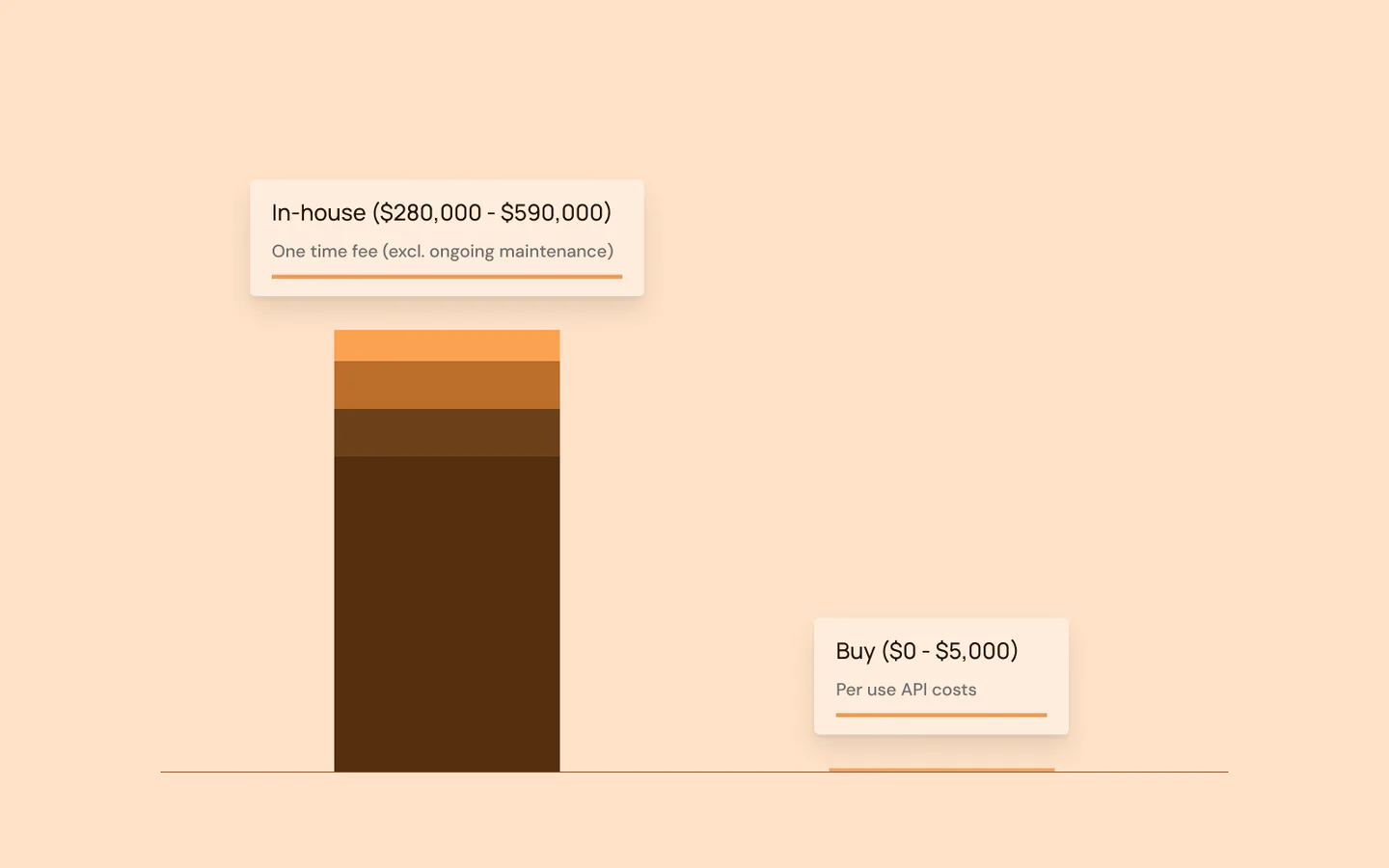
| Total year one | $280,000 - $590,000 |
And after all that investment, first-year accuracy is typically 60 to 75 percent for merchant identification, covering primarily well-known merchants in your primary geography. The long tail of small, regional, and international merchants remains largely unresolved.
Year Two and Beyond: The Maintenance Trap
The ongoing costs of in-house enrichment are where the build option becomes truly expensive relative to buy.
Merchants change constantly. Approximately 5 million new businesses are started each year in the United States alone. Existing merchants rebrand, change payment processors, open new locations, and close old ones. Your merchant database, matching logic, and ML models must evolve continuously to keep up.
New payment methods and wallet providers introduce new transaction descriptor formats that your system must learn to handle. Bank formatting changes break existing parsing rules. International expansion introduces new languages, character sets, and regional payment conventions.
Maintaining and improving an in-house enrichment system requires at least one to two dedicated engineers permanently, plus ongoing infrastructure and data costs. Annual maintenance costs of $150,000 to $250,000 are realistic for a system that does not fall behind.
The hidden cost that teams consistently miss is opportunity cost. Every engineer maintaining your enrichment pipeline is an engineer not building product features that differentiate your business. For most fintech companies, enrichment accuracy is table stakes, not a competitive moat. Spending senior engineering capacity on table stakes is expensive in ways that do not appear on any cost spreadsheet.
What a Transaction Enrichment API Gives You
Integrating a transaction enrichment API instead of building in-house fundamentally changes the cost structure, timeline, and accuracy trajectory.
Integration in Hours, Not Months
A well-designed enrichment API requires minimal integration effort. With the official Triqai Node.js SDK, the core integration is a few lines of code:
import Triqai from "triqai";const triqai = new Triqai(process.env.TRIQAI_API_KEY);const result = await triqai.transactions.enrich({ title: "SQ *VERVE COFFEE ROASTERS LOS ANGELES", country: "US", type: "expense",});console.log(result.data);The SDK is built in TypeScript and ships with full type definitions, automatic retries with exponential backoff, auto-pagination for listing transactions, and built-in error handling with typed error classes. For other languages, the REST API works with a single HTTP request from any stack.
A basic integration can be completed in hours. A production-ready implementation with caching, error handling, retry logic, and monitoring typically takes one to two weeks. Compare that to the six to twelve months required to build even a basic in-house system.
Immediate High Accuracy
Leading enrichment APIs deliver 90 to 95 percent or higher accuracy from day one because they benefit from network effects. Every customer that sends transactions through the system generates patterns that improve the models for all customers. A standalone in-house system, no matter how well-engineered, cannot access this collective intelligence.
Triqai achieves 95%+ accuracy on transaction categorization across 121 categories, with strong coverage across Europe, the US, the UK, and ANZ while supporting all countries globally. Because Triqai reasons about transactions using AI and real-time web context rather than a fixed merchant database, it handles the long tail of small and regional merchants that database-driven systems miss.
Predictable, Scalable Cost
API-based enrichment follows a pay-per-use model with predictable costs. Triqai's pricing starts with a free tier of 100 enrichments per month, making it possible to build and test without any upfront investment. Paid plans scale with usage, and per-enrichment costs decrease at higher volumes.
| Metric | In-house build | API integration |
|---|---|---|
| Time to production | 6-12 months | Hours to days |
| Year one cost | $280,000 - $590,000 | $0 - $5,000 (usage-based) |
| Annual maintenance | $150,000 - $250,000 | $0 (included in per-use pricing) |
| Initial accuracy | 60-75% | 90-95%+ |
| Long-tail merchant coverage | Poor without massive data | Strong (cross-customer network effects) |
| Engineering headcount required | 2-3 dedicated FTEs | 0 dedicated FTEs |
The Five Technical Challenges That Make Building Harder Than Expected
Teams that decide to build often discover that certain technical challenges are far more difficult than anticipated. Understanding these challenges upfront is essential for making an honest build-versus-buy assessment.
1. The Long-Tail Merchant Problem
The top 500 merchants by transaction volume account for roughly half of all consumer transactions. Building enrichment that correctly identifies Starbucks, Amazon, and Netflix is relatively straightforward. The remaining 50 percent of transactions are distributed across millions of smaller merchants, each with low individual frequency but massive collective volume.
Solving the long tail requires either a merchant database with tens of millions of entries (expensive to build and maintain) or AI models sophisticated enough to reason about unfamiliar merchants using contextual clues and web data. In-house systems typically plateau at 70 to 80 percent recognition because they cannot economically cover the long tail.
2. Intermediary Detection and Separation
Modern payments frequently pass through intermediaries. A transaction through Square might appear as SQ *BLUE BOTTLE COFFEE. A PayPal transaction might show PAYPAL *AIRBNB. Apple Pay transactions often arrive with generic descriptors that obscure the underlying merchant entirely.
Production-quality enrichment must detect the intermediary, identify the underlying merchant separately, and return both as distinct entities. Building this requires understanding the descriptor patterns of dozens of payment processors and wallets, each with their own formatting conventions that change over time.
Triqai handles this by reasoning through the full payment chain, identifying both the payment facilitator and the actual business, each with their own name, logo, and metadata. Replicating this logic in-house requires significant domain expertise and continuous adaptation as new payment methods emerge.
3. Multilingual and Multi-Geography Support
Transaction descriptors are not English-only. A financial product that serves users in Japan, Brazil, Germany, and the UAE encounters descriptors in Japanese, Portuguese, German, and Arabic, often using non-Latin scripts. Each geography has its own bank formatting conventions, regional payment processors, and local merchant naming patterns.
Building ML models that generalize across languages and geographies requires diverse training data that is extremely difficult to assemble internally. Most in-house systems start with a single geography and struggle to expand because the engineering investment required for each new market is substantial.
4. Accuracy Measurement and Confidence Calibration
Building an enrichment model is one thing. Knowing how accurate it actually is, and communicating that accuracy reliably to downstream systems, is another.
Proper confidence calibration means that when your system says it is 90 percent confident in a result, it should actually be correct approximately 90 percent of the time. Achieving this requires large, diverse evaluation datasets, statistical methods for calibration, and continuous monitoring as the transaction landscape evolves. Poorly calibrated confidence scores are arguably worse than no confidence scores at all because they mislead downstream decision-making.
5. Keeping Up With Change
The transaction landscape is not static. New merchants appear daily. Existing merchants rebrand, merge, or change payment processors. Banks update their descriptor formatting. New payment methods emerge. Regulatory changes alter how transaction data flows.
An in-house system must evolve continuously to keep up, requiring dedicated engineering effort in perpetuity. An API provider absorbs this maintenance burden across their entire customer base, amortizing the cost and effort of staying current.
A Decision Framework: When to Build and When to Buy
The build-versus-buy decision is not binary. Different situations genuinely favor different approaches. Here is a structured framework for making the decision.
Build In-House When
Enrichment is your core product. If your company's primary value proposition is transaction enrichment itself, building proprietary technology makes strategic sense. Your enrichment quality is your competitive moat, and outsourcing it would undermine your market position.
Regulatory constraints prevent data sharing. Some financial institutions operate under regulations that prohibit sending raw transaction data to third-party processors. In these cases, on-premise or self-hosted enrichment may be the only option.
You have genuinely unique data requirements. If your use case requires enrichment logic that no existing API supports, such as a highly specialized taxonomy, proprietary merchant classification, or enrichment of non-standard financial instruments, building custom logic may be necessary.
You operate at extreme scale with specialized economics. At very high transaction volumes (hundreds of millions per month), the per-transaction cost of an API may exceed the amortized cost of an internal system. But this threshold is much higher than most teams assume, and the comparison must include the full cost of engineering headcount, infrastructure, and opportunity cost.
Buy an API When
Enrichment is infrastructure, not your product. For the vast majority of fintech companies, enrichment is a necessary input to their actual product (budgeting, lending, analytics, PFM). Spending engineering resources on enrichment diverts them from building what actually differentiates your product.
Speed to market matters. If you need enriched transaction data in your product within weeks rather than months, an API is the only realistic path. Waiting six to twelve months to build enrichment from scratch delays every feature that depends on it.
You serve multiple geographies. Building enrichment that works across countries, languages, and payment methods is exponentially harder than single-geography support. An API with global coverage eliminates this complexity entirely.
You do not have dedicated ML engineering capacity. Building and maintaining production ML systems requires specialized skills that many fintech engineering teams do not have. Hiring ML engineers for a non-core capability is expensive and often results in talent retention challenges.
You want accuracy from day one. An API that benefits from cross-customer network effects delivers higher accuracy immediately than any in-house system can achieve in its first year. For banks and financial institutions specifically, the accuracy gap is particularly costly because wrong enrichment displayed to millions of customers generates the very support calls and disputes that enrichment was supposed to prevent. Our guide on transaction enrichment for banks covers the full banking use case.
The Hybrid Approach: Start With an API, Build Later if Needed
For many teams, the smartest strategy is to start with an API and defer the build decision. This approach lets you ship your product quickly, validate market demand, and collect real user feedback about enrichment quality. User corrections on enriched data become labeled training data that you can use later if you decide to build in-house.
If enrichment accuracy becomes a genuine competitive bottleneck that the API cannot solve, you can invest in building with the advantage of production data, a proven accuracy benchmark, and a clear understanding of which specific enrichment problems actually matter for your use case. Most teams that start with this plan discover they never need to build because the API continues to improve and the engineering resources are better spent elsewhere.
Why Triqai Is Built for the Buy Decision
Triqai is designed specifically for fintech teams that have decided to buy rather than build. Several architectural choices reflect this focus.
AI reasoning instead of fixed databases. Triqai combines purpose-built AI models with real-time web context rather than relying on a static merchant dataset. This means Triqai can identify millions of merchants dynamically, including new, small, and regional businesses that no fixed database would cover. The system stays current without manual dataset updates, eliminating one of the biggest maintenance burdens of in-house systems.
Full payment chain resolution. When a transaction passes through a payment intermediary, Triqai separates the processor from the underlying merchant. A transaction through Apple Pay at a local coffee shop returns both the wallet and the actual business, each with their own identity and metadata.
Global coverage from a single endpoint. Triqai processes transactions in local languages including non-Latin scripts, detects regional payment processors, and provides store-level location enrichment across 150+ countries. A single API call handles what would require separate in-house systems for each geography.
Honest confidence scoring. Every enrichment response includes a confidence score that reflects genuine certainty rather than being forced to return a match. This allows your application to make informed decisions about when to display enriched data and when to fall back to the raw descriptor.
Simple integration, zero maintenance. A single POST request returns a complete enrichment response:
curl -X POST https://api.triqai.com/v1/transactions/enrich \ -H "Authorization: Bearer YOUR_API_KEY" \ -H "Content-Type: application/json" \ -d '{ "title": "APPLE PAY *BLUE BOTTLE COFFEE SF", "country": "US", "type": "expense" }'No ML models to train. No merchant databases to maintain. No descriptor patterns to update. Your engineering team stays focused on building the features that make your product unique.
Lessons From Teams That Built (and Switched)
A pattern that appears repeatedly in the fintech industry is teams that start by building in-house, invest six to twelve months, reach 70 to 80 percent accuracy on domestic transactions, and then switch to an API when they realize the remaining 20 to 30 percent requires disproportionate effort to close.
The most common triggers for switching from build to buy are international expansion (building enrichment for a new geography is almost as expensive as building the initial system), the departure of key ML engineers who were the only people who understood the custom models, accuracy stagnation where diminishing returns make each percentage point improvement more expensive than the last, and the realization that engineering resources spent on enrichment are not being spent on the product features that generate revenue.
Teams that switch to an API after building in-house consistently report three things: accuracy improved immediately, engineering headcount requirements dropped, and the product roadmap accelerated because engineers were freed to work on features.
Making Your Decision
The build-versus-buy decision ultimately comes down to one question: is transaction enrichment your product, or is it an input to your product?
If enrichment is your product, build. Invest in it as a core capability. Own the models, the data, and the infrastructure.
If enrichment is an input, buy. Use the best available API, ship your product faster, and spend your engineering budget on the features that actually differentiate your business.
For most fintech teams, the answer is clear. Transaction enrichment is critical infrastructure, but it is not what makes your product unique. An API that delivers 95%+ accuracy from day one, covers 150+ countries, and requires zero ML maintenance is a better use of resources than a multi-year in-house build that may never reach the same level of accuracy.
Start testing with Triqai's free tier and see how enrichment quality compares to your current approach. For JavaScript and Node.js projects, get started in minutes with the official SDK (npm install triqai). For a comprehensive overview of what enrichment APIs deliver, read our complete guide to transaction enrichment. When you are ready to integrate, follow our step-by-step integration guide. The best way to evaluate the build-versus-buy decision is to see what a production-quality API actually delivers on your specific transaction data.
Frequently asked questions
Tags
Related articles

Written by
Wes Dieleman
Founder & CEO at Triqai
March 12, 2026
Wes founded Triqai to make transaction enrichment accessible to every developer and fintech team. With a background in software engineering and financial data systems, he leads Triqai's product vision, AI enrichment research, and API architecture. He writes about transaction data, merchant identification, and building developer-first fintech infrastructure.