How to Integrate a Transaction Enrichment API: Step-by-Step Developer Guide
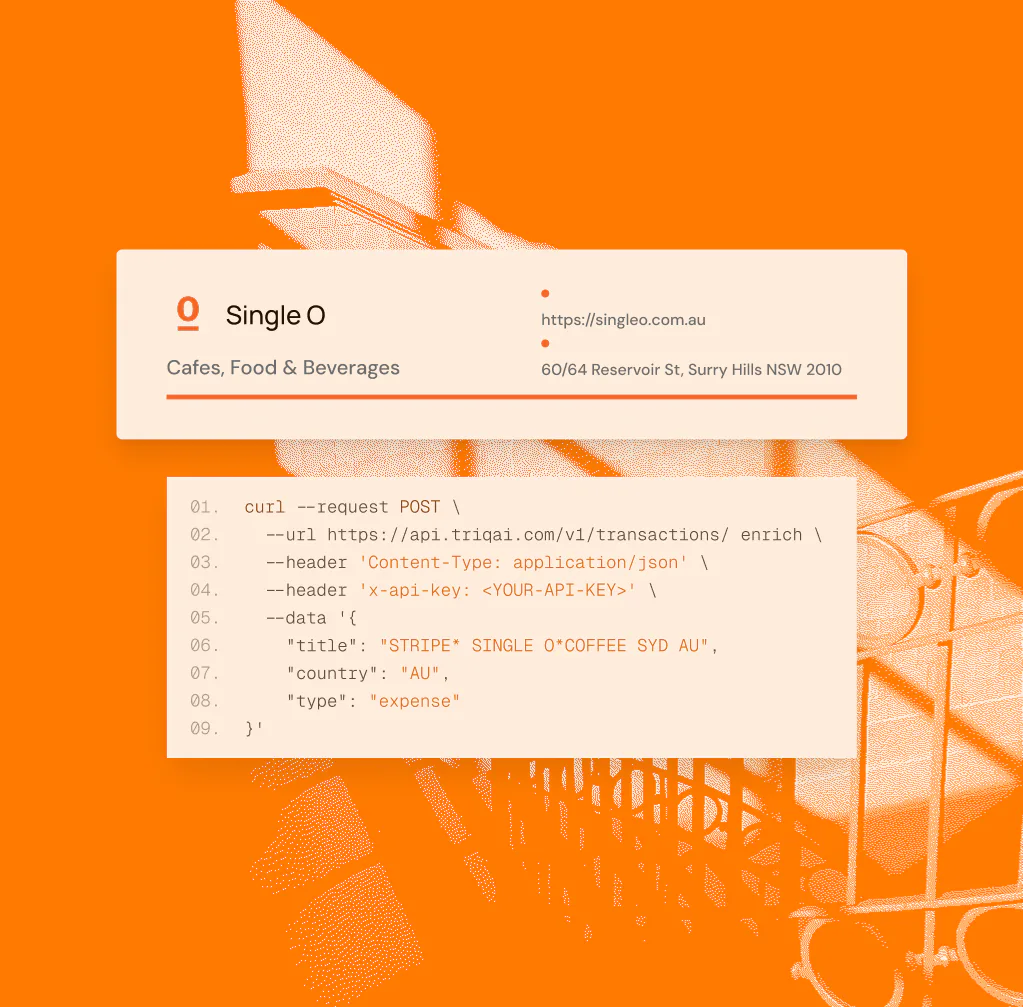
Raw transaction data is the backbone of every financial product, but it arrives broken. Cryptic merchant strings, missing categories, inconsistent formatting across banks and countries. None of it is ready for end users or downstream systems. A transaction enrichment API solves this by transforming messy payment data into structured, meaningful information: clean merchant names, accurate categories, logos, locations, and confidence scores.
But choosing and integrating an enrichment API is not as simple as calling an endpoint. The decision affects data quality across your entire product, shapes how users perceive your app, and determines whether your engineering team spends time building features or debugging merchant mismatches.
This guide walks through the full integration journey: evaluating providers, designing your data pipeline, building the request layer, testing quality, handling edge cases, and scaling a transaction enrichment API in production. Whether you are building a budgeting app, a lending platform, or embedded finance features, this is the practical roadmap your team needs.
Why Transaction Enrichment API Integration Is a Product Decision
Before diving into integration mechanics, it helps to understand what is actually at stake. Integrating a transaction enrichment API is not a cosmetic improvement or a nice-to-have feature. It is an infrastructure decision that affects multiple layers of your product.
User trust depends on data clarity. When a user sees AMAZON MKTPLACE PMTS AMZN.COM/BILL WA in their transaction feed, they do not know what they paid for. That confusion leads to support tickets, disputed charges, and app abandonment. Enrichment turns that string into "Amazon Marketplace" with a logo, a category, and a location, making it instantly recognizable and trustworthy.
Downstream features rely entirely on enriched data. Budgeting tools, spending analytics, credit scoring, and personalized recommendations all depend on accurate merchant identification and categorization. Poor enrichment quality upstream cascades into unreliable features downstream. If your enrichment misidentifies merchants 15% of the time, your budget categories are wrong 15% of the time, your analytics dashboards are misleading, and your users lose confidence in your product.
Manual enrichment simply does not scale. Rule-based systems and internal lookup tables might work for a few hundred merchants, but they collapse as your user base grows across regions, payment methods, and transaction types. A transaction enrichment API that uses AI and web data to dynamically identify merchants externalizes this complexity to a system specifically designed to handle it at scale, without being limited by the size of a fixed dataset. If you are still deciding whether to build enrichment in-house or use an API, our build vs. buy guide covers the costs, timelines, and technical trade-offs in detail.
How to Evaluate Transaction Enrichment API Providers
Not all enrichment APIs deliver the same results. When evaluating providers, go beyond marketing claims and test against the data patterns your product actually encounters.
The most important test is accuracy on your actual data, not published benchmarks. Every provider publishes accuracy numbers, but those metrics are typically measured on curated datasets biased toward well-known merchants in major markets. What matters is how the API performs on your specific transaction feed, including the long tail of small, regional, and international merchants that make up a significant portion of real-world transactions. Providers that rely on a fixed merchant dataset will inevitably have gaps; look for providers like Triqai that use AI and web-derived context to identify merchants dynamically, as these tend to handle the long tail far better. Request a trial period and run your own evaluation against a representative sample of production data. Measure the merchant recognition rate, categorization accuracy, and the percentage of transactions that come back as "unknown" or "other."
Geographic and payment type coverage matters more than most teams realize. If your product operates in multiple countries, check whether the API handles local banks, regional payment processors, and non-Latin scripts. Many providers are optimized for North American or Western European transactions and underperform significantly in other markets. Similarly, test across different payment types: card payments, bank transfers, wallet transactions from Apple Pay and Google Pay, marketplace purchases, and peer-to-peer transfers. Each presents different challenges for enrichment.
Examine the actual API response structure and metadata depth. A good transaction enrichment API returns more than a clean name and a category. Look for normalized merchant names, primary and secondary and tertiary categories, merchant logo URLs, location data with structured addresses and coordinates, payment channel identification, intermediary identification that separates payment processors from underlying merchants, and confidence scores for each field. Confidence scores are particularly critical because they allow your application to make informed decisions about displaying enriched data versus falling back to a safer representation.
Latency and throughput must meet your specific use case. For real-time transaction feeds, enrichment should return results within one to two seconds. For batch processing such as historical data migration, check throughput limits and whether the API supports bulk endpoints. Verify rate limits against your expected peak volume.
Data privacy and compliance are non-negotiable for financial data. Verify that the provider is GDPR-compliant, does not retain raw transaction data beyond what is necessary for processing, and provides clear documentation about data handling practices. For regulated industries like banking and lending, compliance is a hard requirement.
Designing Your Transaction Enrichment Architecture
How you integrate the enrichment API into your system determines how resilient, maintainable, and performant the enrichment pipeline becomes. Getting the architecture right upfront saves significant rework later.
The first architectural decision is whether to enrich transactions synchronously or asynchronously. Synchronous enrichment processes transactions at the time of ingestion, returning enriched data immediately. This is appropriate when users expect real-time results, such as in a live transaction feed where each payment appears fully enriched within seconds of being received. The trade-off is added latency to your transaction processing path and tighter coupling to the API's availability.
Asynchronous enrichment processes transactions in a background pipeline, decoupled from the ingestion path. This works better for batch processing, historical data imports, or systems where a slight delay in enrichment is acceptable. It allows you to decouple enrichment from ingestion, retry failed requests without blocking, and handle rate limits gracefully.
In practice, most production systems use a hybrid approach: enrich synchronously where latency is acceptable and the transaction feed is real-time, then fall back to asynchronous processing for failures, high-load periods, or batch operations. This gives users a fast experience while maintaining system resilience.
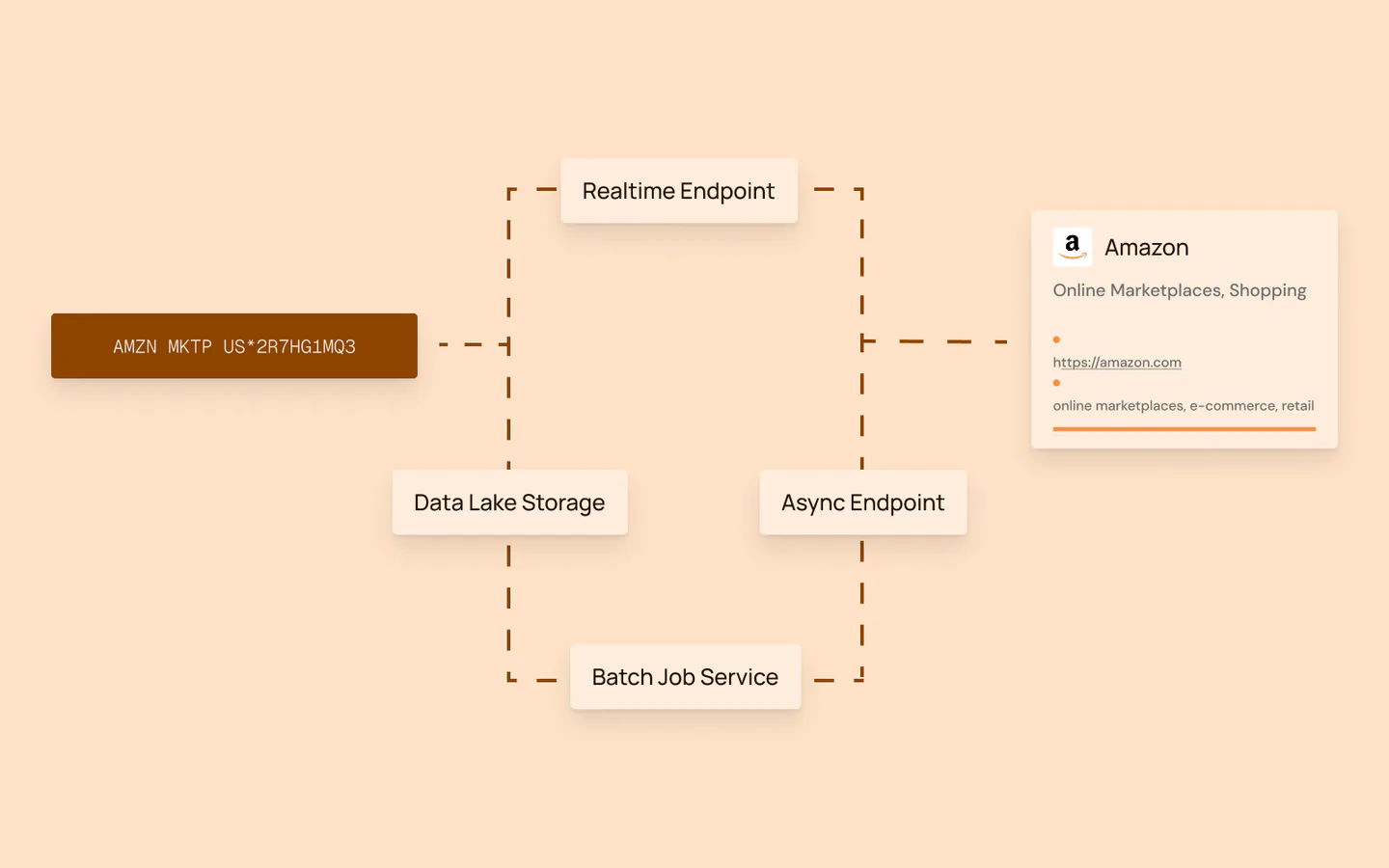
The second critical decision is to always store raw and enriched data separately. Never discard the original transaction data after enrichment. Storing both versions serves multiple purposes: re-enrichment becomes possible as the API's models improve over time, debugging is easier when you can compare raw input against enriched output, user corrections can be applied without losing the original data, and compliance requirements may mandate retention of source records. A common pattern is to store the raw transaction in one table and the enrichment result in a linked table with a timestamp indicating when enrichment was last applied.
Your architecture must handle API failures gracefully because any external dependency can fail. If you are using JavaScript or Node.js, the official Triqai SDK (npm install triqai) handles retries with exponential backoff automatically, so you get resilient enrichment out of the box:
import Triqai from "triqai";const triqai = new Triqai(process.env.TRIQAI_API_KEY, { maxRetries: 3, retryDelay: 500,});async function enrichTransaction(transaction) { try { const result = await triqai.transactions.enrich({ title: transaction.description, country: transaction.countryCode, type: transaction.type, }); return result.data; } catch (error) { await addToDeadLetterQueue(transaction); return null; }}The SDK automatically retries on transient errors (429, 500, 503, 504, and network failures) with exponential backoff and respects Retry-After headers. If you are not using Node.js, you can implement retry logic manually with the REST API:
async function enrichTransaction(transaction, retries = 3) { for (let attempt = 0; attempt < retries; attempt++) { try { const response = await fetch("https://api.triqai.com/v1/transactions/enrich", { method: "POST", headers: { Authorization: `Bearer ${process.env.TRIQAI_API_KEY}`, "Content-Type": "application/json", }, body: JSON.stringify({ title: transaction.description, country: transaction.countryCode, type: transaction.type, }), }); if (response.status === 429) { const delay = Math.pow(2, attempt) * 1000; await new Promise((r) => setTimeout(r, delay)); continue; } if (!response.ok) throw new Error(`API error: ${response.status}`); return await response.json(); } catch (error) { if (attempt === retries - 1) { await addToDeadLetterQueue(transaction); return null; } const delay = Math.pow(2, attempt) * 1000; await new Promise((r) => setTimeout(r, delay)); } }}Maintain a dead-letter queue for transactions that fail enrichment after multiple attempts, and process them when the API recovers. Ensure your UI can display raw transaction data as a fallback when enrichment is temporarily unavailable. Users should never see a blank or broken transaction entry.
Caching enrichment results is essential for both performance and cost management. If the same merchant descriptor appears repeatedly across transactions, which is extremely common, caching results at the descriptor level significantly reduces API calls and improves response times. Here is a caching pattern using a simple key-value store:
const CACHE_TTL = 48 * 60 * 60 * 1000; // 48 hoursasync function enrichWithCache(transaction, cache) { const cacheKey = `enrich:${transaction.description}:${transaction.countryCode}`; const cached = await cache.get(cacheKey); if (cached) return JSON.parse(cached); const result = await enrichTransaction(transaction); if (result) { await cache.set(cacheKey, JSON.stringify(result), CACHE_TTL); } return result;}Set cache expiration thoughtfully; merchant data changes infrequently, but the provider may update categories or metadata periodically. A cache TTL of 24 to 72 hours is a reasonable starting point.
Building the API Request Pipeline
Once architecture decisions are made, the practical work of building the integration begins. The quality of your implementation directly affects enrichment accuracy and system reliability.
The quality of enrichment output depends heavily on input quality, so normalize your data before sending it to the API. Trim whitespace and control characters from descriptor strings. Remove duplicate transaction entries. Include all available metadata fields (MCC codes, currency, country codes, transaction amounts, and dates) because additional context improves accuracy. Ensure date formats and currency codes are consistent across your data sources.
When structuring API requests, a typical enrichment call sends raw transaction data and receives structured results. The simplest way to get started with JavaScript or Node.js is to use the official Triqai SDK:
import Triqai from "triqai";const triqai = new Triqai(process.env.TRIQAI_API_KEY);const result = await triqai.transactions.enrich({ title: "APPLE PAY *SALOMON PYMNT 14/04 LONDON", country: "GB", type: "expense",});console.log(result.data.entities); // merchant, location, intermediaryconsole.log(result.data.transaction.category.primary.name); // "Shopping"Here is the same request using curl:
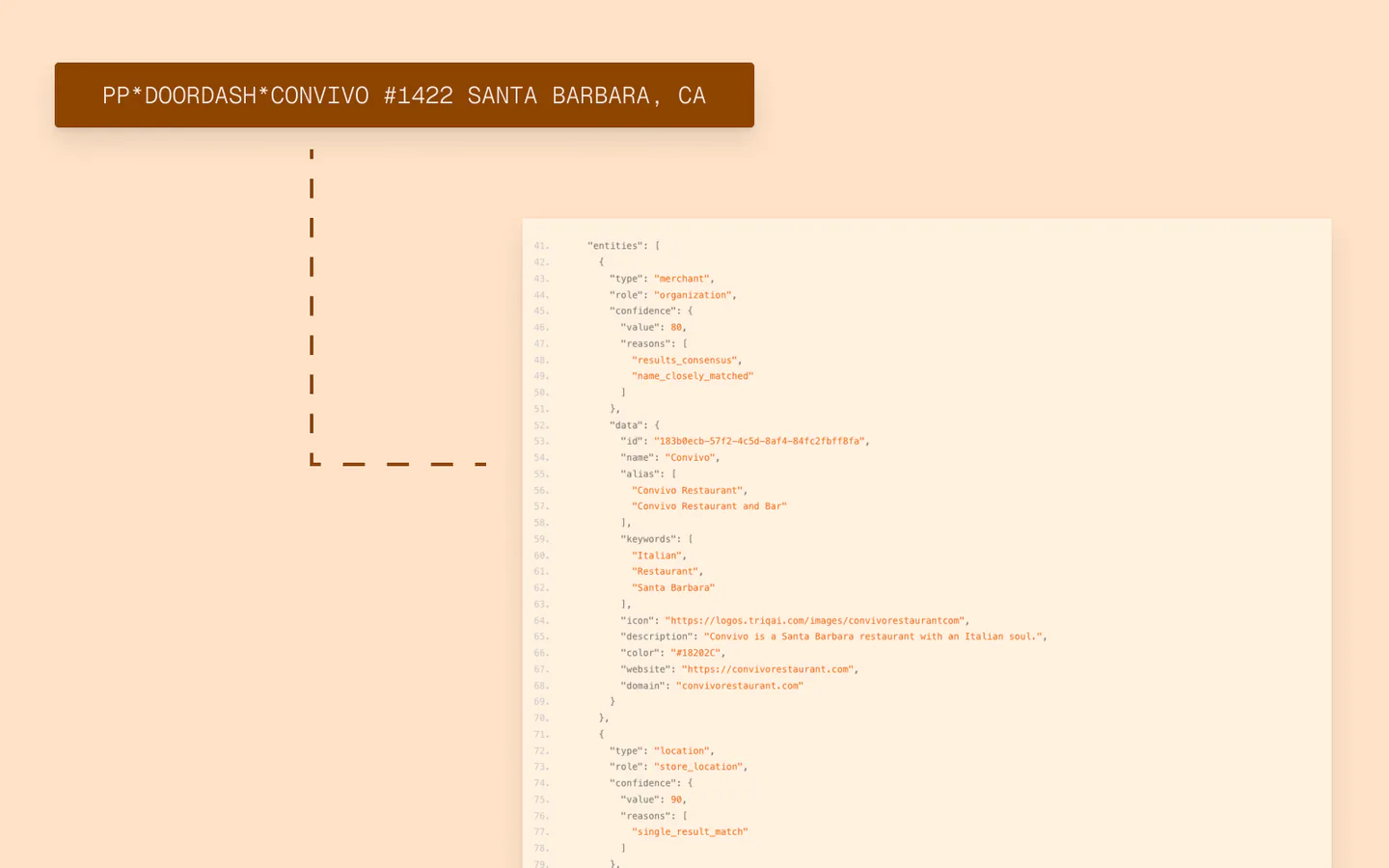
curl -X POST https://api.triqai.com/v1/transactions/enrich \ -H "Authorization: Bearer YOUR_API_KEY" \ -H "Content-Type: application/json" \ -d '{ "title": "APPLE PAY *SALOMON PYMNT 14/04 LONDON", "country": "GB", "type": "expense" }'The API returns a structured enrichment response with merchant identity, hierarchical categories, location data, payment context, and confidence scores:
{ "merchant": { "name": "Salomon", "logo": "https://logos.triqai.com/images/salomoncom", "website": "https://www.salomon.com", "id": "merch_salomon_gb" }, "category": { "primary": "Shopping", "secondary": "Clothing and Accessories", "tertiary": "Sportswear" }, "location": { "city": "London", "country": "GB", "formatted": "London, United Kingdom" }, "intermediary": { "name": "Apple Pay", "type": "wallet" }, "type": "expense", "channel": "in_store", "confidence": 0.94}Here is the same request using fetch directly (for environments where the SDK is not available):
const response = await fetch("https://api.triqai.com/v1/transactions/enrich", { method: "POST", headers: { Authorization: `Bearer ${process.env.TRIQAI_API_KEY}`, "Content-Type": "application/json", }, body: JSON.stringify({ title: "APPLE PAY *SALOMON PYMNT 14/04 LONDON", country: "GB", type: "expense", }),});const enrichment = await response.json();console.log(enrichment.merchant.name); // "Salomon"console.log(enrichment.category.primary); // "Shopping"console.log(enrichment.confidence); // 0.94And in Python using requests:
import requestsresponse = requests.post( "https://api.triqai.com/v1/transactions/enrich", headers={"Authorization": f"Bearer {TRIQAI_API_KEY}"}, json={ "title": "APPLE PAY *SALOMON PYMNT 14/04 LONDON", "country": "GB", "type": "expense", },)enrichment = response.json()print(enrichment["merchant"]["name"]) # "Salomon"print(enrichment["category"]["primary"]) # "Shopping"print(enrichment["confidence"]) # 0.94Always map your internal transaction ID to the API response so you can reliably match results back to your records.
For throughput efficiency, use batch processing whenever possible. Group transactions by time window or count (batches of 50 to 100 transactions every few seconds) to balance latency against network efficiency. For real-time use cases where batching introduces unacceptable delay, single-transaction calls are appropriate, but monitor your volume carefully to stay within rate limits. Most enrichment APIs, including Triqai, support both single and batch endpoints.
Testing and Validating Enrichment Quality
Integration is only the beginning. Ongoing validation ensures enrichment quality remains high as your user base grows and the transaction landscape evolves.
Build a curated validation dataset that represents the full diversity of transactions your product handles. Include common domestic merchants like large chains and subscription services, long-tail merchants like small businesses and local shops, international transactions with non-English descriptors, wallet-mediated payments from Apple Pay and Google Pay, peer-to-peer transfers and marketplace purchases, and ambiguous or generic descriptors like "POS PAYMENT" or "CARD PURCHASE." Manually label this dataset with correct merchant names and categories, then use it as a benchmark to evaluate enrichment quality over time and across providers.
Track metrics that reflect real user impact, not just headline accuracy. The most important metrics are merchant recognition rate (the percentage of transactions where a merchant is identified rather than returned as unknown), category accuracy against your labeled dataset, confidence calibration (whether a confidence score of 0.9 actually correlates with being correct 90% of the time), latency percentiles including p50, p95, and p99 response times under realistic load, and error rate as the percentage of API calls that fail or timeout.
Set up production monitoring dashboards and alerts for these metrics. Sudden drops in recognition rate might indicate changes in bank formatting, new transaction sources your system does not cover, or issues on the provider's side. Periodically re-run your validation dataset against the API to detect quality drift. If accuracy degrades on certain transaction segments, flag those patterns for investigation.
Handling Edge Cases in Production
Real-world transaction data is messy, and even the best transaction enrichment API will encounter cases it cannot resolve confidently. How your product handles these cases separates a polished experience from a frustrating one.
For low-confidence results where the API returns a confidence score below your threshold, consider displaying the raw transaction descriptor alongside the enriched result. Here is a pattern for confidence-based display logic:
function getDisplayName(enrichment, rawDescription) { if (!enrichment) return rawDescription; if (enrichment.confidence >= 0.8) return enrichment.merchant.name; if (enrichment.confidence >= 0.5) { return `${enrichment.merchant.name} (${rawDescription})`; } return rawDescription;}Users lose trust faster from wrong enrichment than from no enrichment at all.
Digital wallets and marketplaces are inherently harder to enrich because they abstract the underlying merchant. Apple Pay, Google Pay, and PayPal transactions often arrive with generic descriptors that obscure who the user actually paid. Triqai handles this by detecting the intermediary separately from the underlying merchant when possible, but some wallet transactions will always have limited merchant visibility. Design your UI to communicate this honestly: display the wallet or platform name and note when the specific merchant could not be identified. For a deeper look at this challenge, read our guide on why wallet transactions are harder to enrich.
Allow users to correct merchant names and categories. These corrections serve dual purposes: they improve the immediate user experience, and they generate labeled data that can be used to evaluate and refine enrichment accuracy over time. Store user corrections separately from API enrichment results so that manual adjustments are never overwritten by automated re-enrichment.
Optimizing Costs and Performance at Scale
As transaction volume grows, so does the cost and operational complexity of enrichment. Proactive optimization keeps both manageable.
Not every transaction needs enrichment. Internal transfers between the user's own accounts, ATM withdrawals, and administrative transactions like fees and interest payments do not benefit from merchant enrichment. Filter these out before sending them to the API to reduce unnecessary costs.
Descriptor-level caching is the single most effective cost optimization. If you have already successfully enriched a descriptor string recently, serve the cached result instead of making a redundant API call. In most fintech products, a relatively small number of unique descriptor strings account for a large portion of total transactions, making caching highly effective.
As your volume grows, review your pricing tier and negotiate terms. Enrichment API pricing typically follows a per-transaction model with volume discounts. Triqai offers transparent tiered pricing starting with a free tier of 100 enrichments per month, scaling through Starter, Growth, and Business plans with decreasing per-enrichment costs at higher volumes.
For mission-critical systems, consider maintaining a tested fallback integration with a secondary provider. This does not mean running two providers simultaneously for every transaction. It means having a backup that can be activated if your primary provider experiences extended downtime.
When to Re-evaluate Your Enrichment Integration
Transaction enrichment API integration is not a set-and-forget task. Revisit your approach when your product expands to new geographies with different banking systems, when you add new transaction sources like new bank connections or wallet integrations, when user feedback indicates recurring categorization issues, when your provider's accuracy on your validation dataset declines meaningfully, or when new enrichment providers enter the market with better coverage for your use case.
The enrichment landscape is evolving rapidly. AI-driven approaches that use web data and contextual reasoning increasingly outperform fixed-dataset systems, especially for the long tail of small, regional, and emerging merchants. Providers that rely on static datasets will always lag behind reality, while providers like Triqai that reason dynamically using web context can adapt without manual dataset updates. Staying current ensures your product benefits from the latest improvements in the field.
Conclusion
Integrating a transaction enrichment API is one of the most impactful infrastructure decisions for any financial product. Done well, it transforms raw payment data into the clean, structured information that powers accurate analytics, trustworthy user interfaces, and intelligent features. Done poorly, it introduces silent data quality issues that erode user trust and complicate every downstream system.
The key is to treat enrichment as an ongoing engineering discipline rather than a one-time integration task. Evaluate providers rigorously against your real data. Design resilient architecture with proper caching and fallbacks. Test continuously with representative datasets. Handle edge cases with transparency rather than overconfidence. And optimize proactively as your scale grows.
Your users will never see the enrichment pipeline directly. But they will instantly feel the difference between a financial app that understands their transactions and one that shows them cryptic bank strings. Get started with Triqai's transaction enrichment API and ship that difference in days, not months. For JavaScript and Node.js projects, install the official SDK with npm install triqai to get started even faster with built-in retries, full TypeScript support, and auto-pagination.
Frequently asked questions
Tags
Related articles

Written by
Wes Dieleman
Founder & CEO at Triqai
March 2, 2026
Wes founded Triqai to make transaction enrichment accessible to every developer and fintech team. With a background in software engineering and financial data systems, he leads Triqai's product vision, AI enrichment research, and API architecture. He writes about transaction data, merchant identification, and building developer-first fintech infrastructure.