Automated Transaction Categorization: Best Practices for Accurate Classification at Scale
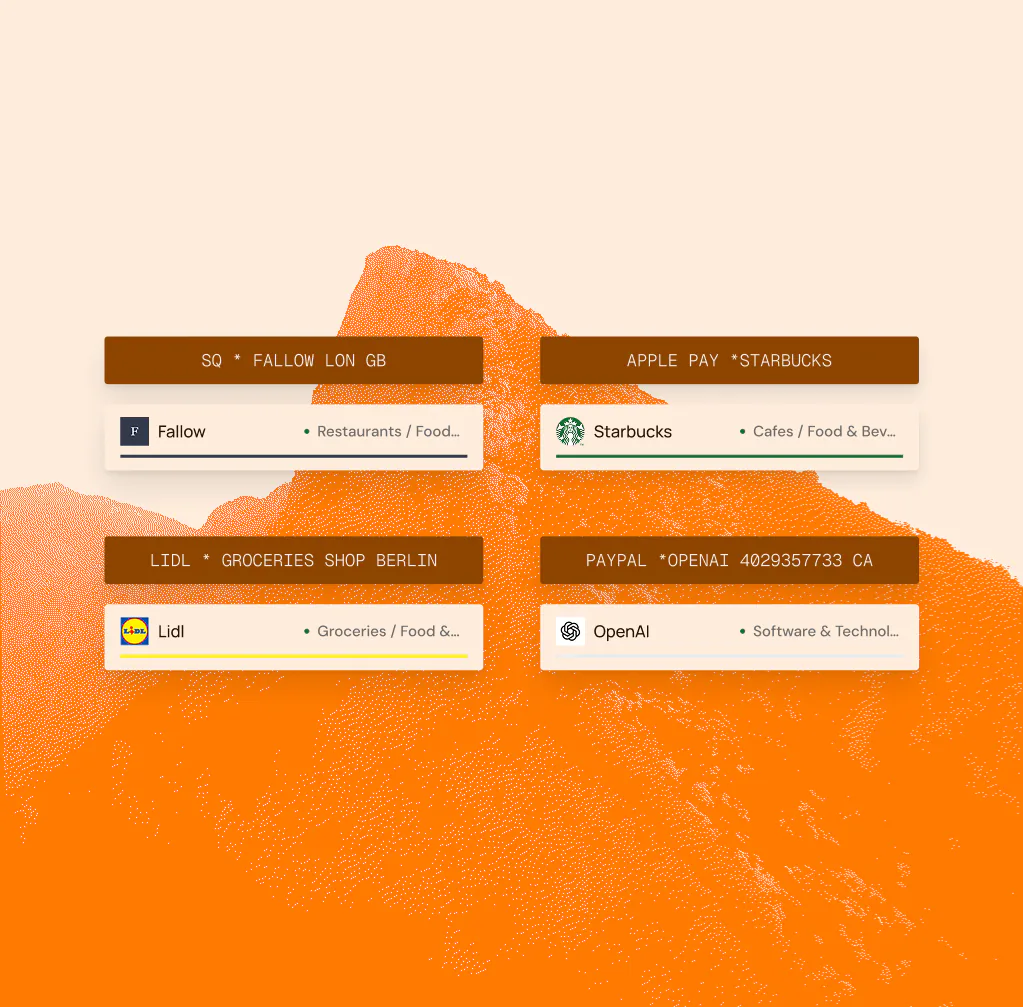
Accurate automated transaction categorization is one of the most demanded yet most difficult capabilities in fintech. Every budgeting app, banking product, expense management platform, and lending system depends on it. When categorization works well, users trust their financial tools and engage more deeply. When it fails, users see their gym membership filed under "Shopping" or their Uber Eats order labeled as "Transportation," and confidence in the entire product erodes.
The difficulty is not building a categorization system. Any developer can write a function that maps merchant names to categories. The difficulty is building one that works accurately across the full diversity of real-world transactions: millions of merchants, dozens of countries, hundreds of bank formatting conventions, and constant change as new businesses open, existing ones rebrand, and payment methods evolve.
This article provides a practical guide to implementing accurate transaction categorization at scale. It covers the approaches that work, the ones that do not, how to design your taxonomy, how to measure accuracy honestly, how to handle edge cases, and why an enrichment-first approach consistently outperforms standalone categorization systems.
Why Transaction Categorization Is Harder Than It Looks
Teams building categorization for the first time typically underestimate the problem. The top 500 merchants are easy. Starbucks is "Coffee," Netflix is "Entertainment," and Shell is "Fuel." But those 500 merchants represent only about half of all consumer transactions. The other half is distributed across millions of smaller, regional, and niche businesses, each appearing in different formats across different banks.
Our detailed analysis of why transaction categorization is hard covers the structural challenges in depth. The core issues are worth summarizing here because they directly inform best practices.
Raw transaction data lacks semantic meaning. A descriptor like POS 4829 MISC RETAIL #7123 contains no useful signal for categorization. The MCC code embedded in it (4829) describes "wire transfer" rather than what the user actually purchased.
The same merchant spans multiple categories. Amazon sells groceries, electronics, books, clothing, and digital subscriptions. Walmart sells food, pharmacy items, auto parts, and home goods. Without knowing what was purchased (which transaction data does not reveal), any single category assignment is incomplete.
Payment intermediaries obscure the actual merchant. A transaction through Square, PayPal, or Apple Pay may show the processor name rather than the underlying business. Categorizing a PayPal transaction as "Financial Services" because PayPal is a financial company completely misrepresents the user's actual spending.
Bank formatting is inconsistent and changes over time. The same merchant appears differently across banks, and banks periodically change their descriptor formatting, breaking rules that previously worked.
These are not edge cases. They represent a substantial portion of real transaction volume and are the primary reason that simple categorization approaches plateau at 60 to 75 percent accuracy.
Three Approaches to Automated Categorization
Transaction categorization implementations broadly fall into three approaches, each with distinct accuracy ceilings and maintenance requirements.
Approach 1: Rule-Based and MCC Code Mapping
The simplest approach maps MCC codes to categories and supplements with string-matching rules. If the descriptor contains "STARBUCKS," categorize as "Coffee." If the MCC code is 5411, categorize as "Groceries."
This approach is fast to build, easy to understand, and works well for demos and prototypes. It typically achieves 50 to 70 percent accuracy on real transaction data.
The limitations are fundamental. MCC codes describe the merchant type, not the transaction type. Rules are brittle and break when bank formatting changes. The approach cannot handle ambiguity, context, or new merchants. And maintaining thousands of rules across multiple markets becomes a full-time job that scales linearly with coverage.
function categorizeByRules(description, mccCode) { if (mccCode === "5411") return "Groceries"; if (mccCode === "5812") return "Restaurants"; if (description.includes("UBER")) return "Transportation"; // But what about Uber Eats? That's dining, not transportation. // And "SBX*STARBUCKS" won't match a "STARBUCKS" rule. return "Uncategorized";}For production fintech products, rule-based categorization alone is insufficient. Users notice when their grocery run at Target is categorized as "Shopping" or their Uber Eats dinner is filed under "Transportation."
Approach 2: Machine Learning Classification
ML-based categorization trains models on labeled transaction data to learn patterns beyond explicit rules. The model learns that descriptors containing "SBX" followed by an asterisk likely refer to Starbucks, that amounts between $3 and $7 with certain merchant patterns are probably coffee purchases, and so on.
This approach typically achieves 75 to 85 percent accuracy with sufficient training data and reaches higher accuracy for well-represented merchants and markets.
The challenges are in data acquisition and maintenance. Training accurate models requires diverse, high-quality labeled data from multiple banks, geographies, and payment types. Industry estimates suggest 100+ million labeled transactions are needed for a model that generalizes well. Models must be continuously retrained as merchant patterns, bank formatting, and payment methods evolve. And even well-trained models struggle with the long tail of small and regional merchants that appear infrequently in training data.
Approach 3: Enrichment-First Categorization
The most effective approach separates merchant identification from categorization. Instead of trying to infer a category directly from the raw descriptor, the system first resolves the merchant identity through enrichment, then maps the known merchant to a category.
This is the approach that Triqai and other leading enrichment APIs use. When the system knows the merchant is "Verve Coffee Roasters" rather than just seeing SQ *VERVE COFFEE ROASTERS SF, categorization becomes a straightforward merchant-type-to-category mapping. The hard problem of parsing noisy text is solved upstream in the enrichment layer, and categorization operates on clean, structured inputs.
This approach achieves 90 to 95 percent or higher accuracy because it eliminates the ambiguity that causes most categorization errors. As we explain in our analysis of the evolution from rules to AI-powered enrichment, modern AI-based enrichment APIs reason about transactions using web context and contextual signals, identifying merchants that no rule or static database would cover.
| Approach | Typical accuracy | Build effort | Maintenance | Best for |
|---|---|---|---|---|
| Rule-based / MCC | 50-70% | Days | High (constant rule updates) | Prototypes, demos |
| ML classification | 75-85% | Months | Medium (retraining, data) | In-house teams with ML expertise |
| Enrichment-first | 90-95%+ | Hours (API integration) | None (provider maintains) | Production fintech products |
Designing Your Category Taxonomy
The taxonomy you choose, the actual list and hierarchy of categories, has a direct impact on accuracy, user experience, and analytical usefulness. A poorly designed taxonomy forces categorization into awkward buckets that frustrate users. A well-designed one feels natural and supports both high-level budgeting and detailed spending analysis.
Hierarchical Depth
The most flexible taxonomies support at least two levels: primary categories for broad groupings and secondary categories for specificity. Three levels provide even more analytical power.
A grocery purchase at Whole Foods might be categorized as:
- Primary: Food and Drink
- Secondary: Groceries
- Tertiary: Organic and Specialty
This hierarchy lets your UI show "Food and Drink" in a budget pie chart while displaying "Groceries - Organic and Specialty" in a detailed transaction list.
Triqai's categorization engine supports three hierarchical levels across 121 categories, with 69 expense categories and 38 income categories. This depth gives developers flexibility to present the right level of detail for each context without building custom taxonomy mapping.
Income vs. Expense Separation
Many categorization systems treat all transactions the same, but income and expense transactions require fundamentally different categories. A payroll deposit should not be categorized using the same taxonomy as a restaurant purchase. Salary, freelance income, investment returns, rental income, and tax refunds are all income categories that have no parallel in expense categorization.
Ensure your taxonomy or your enrichment provider separates income from expense categories. This prevents confusion in analytics and budgeting interfaces where income and expenses need to be tracked independently.
Category Count
Too few categories (under 10) produce groupings so broad they are unhelpful. A single "Services" category that includes gym memberships, haircuts, car washes, and legal fees provides no analytical value.
Too many categories (over 200) create classification difficulty. The more granular the taxonomy, the harder it is to categorize consistently, and the more likely users are to disagree with assignments. A user might not care whether their coffee purchase is "Coffee and Cafes" or "Quick Service Restaurants" but will be frustrated if the system inconsistently assigns it to both.
The sweet spot for most consumer fintech products is 15 to 30 primary categories with 60 to 120 sub-categories. This provides meaningful granularity without over-splitting.
Measuring Categorization Accuracy Honestly
Accuracy measurement is where many teams deceive themselves. The headline accuracy number, often 85 or 90 percent, hides critical details about how and what was measured.
Precision and Recall by Category
Overall accuracy masks category-level performance. A system might correctly categorize 99 percent of Starbucks transactions (easy) while miscategorizing 60 percent of utility charges (hard). If Starbucks transactions appear 100 times in the test set and utility payments appear 10 times, the overall accuracy looks high even though an entire use case is broken.
Measure precision (how often a predicted category is correct) and recall (how often transactions in a category are found) for each individual category. This reveals which categories your system handles well and which need improvement.
Test on Real Production Data
Accuracy measured on curated benchmark datasets overstates real-world performance. Benchmark datasets are biased toward well-known merchants and clean formatting. Real production data includes the long tail of small merchants, messy formatting, and edge cases that benchmarks miss.
The only honest accuracy measurement uses a random sample of real production transactions, manually labeled by human reviewers, and compared against your system's output. This is expensive and time-consuming, but it is the only way to know your actual accuracy.
Account for "Uncategorized" in Your Metrics
Some systems boost their accuracy number by excluding transactions they cannot categorize. If a system correctly categorizes 90 percent of the transactions it attempts but declines to categorize 20 percent of all transactions, the effective accuracy is 72 percent, not 90 percent.
Always report accuracy as a percentage of all transactions, including those returned as uncategorized. This gives a realistic picture of what users actually experience.
Handling Edge Cases in Production
Certain transaction types consistently cause categorization errors. Designing explicit handling for these cases significantly improves the user experience.
Multi-Category Merchants
Merchants like Amazon, Walmart, and Costco sell products spanning many categories. Since transaction data does not reveal what was purchased, any single category assignment is a guess.
The best practice is to assign the merchant's most common category (for Amazon, typically "Shopping - Online Marketplaces") and accept that some individual transactions will be miscategorized. This is more useful than creating a generic "Multi-Category" bucket that provides no information at all.
Alternatively, use the confidence score to signal uncertainty. When the enrichment response indicates lower confidence for a multi-category merchant, your UI can invite the user to confirm or change the category.
Payment Intermediary Transactions
Transactions through Square, PayPal, Stripe, and digital wallets like Apple Pay require special handling. The raw descriptor often shows the intermediary rather than the actual merchant.
An enrichment-first approach handles this by separating the intermediary from the underlying merchant. Triqai's object enrichment identifies both the payment facilitator and the actual business, each with their own identity, enabling accurate categorization of the underlying purchase rather than the payment method.
Without this separation, wallet transactions default to categories like "Technology" or "Financial Services," which is meaningless for budgeting purposes.
Subscriptions and Recurring Payments
Subscription charges appear with identical formatting month after month but span wildly different categories. A $9.99 monthly charge could be music streaming (Entertainment), cloud storage (Technology), news (Media), fitness (Health), or software (Business Tools).
The key to accurate subscription categorization is merchant identification. Once the system knows the charge is from Spotify versus iCloud versus The New York Times, categorization is straightforward. Without merchant identification, the amount and recurrence pattern alone provide zero category signal.
International and Non-Latin Transactions
Transactions from non-English-speaking countries introduce character set challenges, local abbreviations, and regional formatting patterns. A categorization system trained primarily on English-language data from North America and Europe will underperform on Japanese, Korean, Arabic, or Thai transaction descriptors.
Using an enrichment API with global coverage addresses this by handling multi-language merchant resolution upstream. Triqai processes transactions in local languages including non-Latin scripts across 150+ countries, ensuring categorization works regardless of the transaction's origin.
Implementing Categorization With an Enrichment API
For teams choosing the enrichment-first approach, implementation is straightforward. The enrichment API handles merchant identification, categorization, and all the edge cases described above. Your application receives structured data and presents it to users.
With Triqai's API, a single call returns the merchant identity and category together:
import Triqai from "triqai";const triqai = new Triqai(process.env.TRIQAI_API_KEY);const result = await triqai.transactions.enrich({ title: "PAYPAL *SPOTIFY AB", country: "US", type: "expense",});const { category, confidence } = result.data;The response includes the full category hierarchy and confidence score:
{ "merchant": { "name": "Spotify", "logo": "https://logos.triqai.com/images/spotifycom" }, "category": { "primary": "Entertainment", "secondary": "Music and Audio", "tertiary": "Music Streaming" }, "intermediary": { "name": "PayPal", "type": "payment_facilitator" }, "confidence": 0.97}Notice that the intermediary (PayPal) is separated from the merchant (Spotify), and the category reflects the actual service (Music Streaming) rather than the payment processor.
Using Confidence Scores in Your UI
Confidence scores are the most underutilized feature in categorization APIs. Using them effectively dramatically improves user trust.
function displayCategory(enrichment) { const { category, confidence } = enrichment; if (confidence >= 0.85) { return category.secondary || category.primary; } if (confidence >= 0.60) { return category.primary; } return null; // show raw descriptor or ask user}High-confidence transactions (above 85%) can display the specific sub-category. Medium-confidence transactions (60-85%) should fall back to the broader primary category, which is more likely to be correct. Low-confidence transactions (below 60%) should not display a category at all or should prompt the user to categorize manually.
Respecting User Corrections
When a user manually recategorizes a transaction, that correction must persist through re-enrichment cycles. Store user overrides separately from API-derived categories:
async function getTransactionCategory(transaction) { if (transaction.userOverrideCategory) { return transaction.userOverrideCategory; } const enrichment = await enrichTransaction(transaction); return displayCategory(enrichment);}User corrections serve two purposes: they ensure the user's preference is respected, and they provide labeled data that you can use to evaluate categorization quality over time. If users consistently recategorize a specific merchant, it signals a systematic issue worth investigating.
Scaling Categorization Across Markets
International expansion is where most in-house categorization systems break down. Each new market introduces local merchants, regional payment conventions, and formatting patterns that existing models do not handle.
Building separate categorization models per market is expensive and slow. Each market requires local training data, local merchant databases, and ongoing maintenance. Three markets means three times the engineering effort.
An enrichment API with global coverage collapses this complexity into a single integration. Triqai handles transactions across 150+ countries from a single endpoint, resolving local merchants, processing non-Latin scripts, and categorizing according to a consistent taxonomy regardless of the transaction's origin.
For teams planning international expansion, this is one of the strongest arguments for the enrichment-first approach. The alternative, building and maintaining categorization models for each market, is a perpetual engineering tax that grows with every new geography. Our build vs. buy framework covers the full cost comparison.
Conclusion
Automated transaction categorization at production quality requires more than clever rules or trained ML models. It requires solving the upstream problem of merchant identification first. When a categorization system knows the merchant is "Verve Coffee Roasters" rather than parsing SQ *VERVE COFFEE SF, the categorization problem becomes straightforward.
The enrichment-first approach, where an API resolves merchant identity, detects intermediaries, and extracts context before categorization runs, consistently outperforms standalone categorization systems. It achieves 90 to 95 percent or higher accuracy from day one, handles edge cases like multi-category merchants and digital wallets, scales across geographies without per-market engineering effort, and requires zero ML infrastructure or maintenance.
For fintech teams building products that depend on accurate spending categories, integrating a proven enrichment API like Triqai is the fastest path to categorization that users trust. Start with the free tier to test accuracy on your own transaction data, explore the interactive playground to see categorization in action, or follow our step-by-step integration guide to go from testing to production in days. The difference between categorization that frustrates users and categorization that builds trust comes down to the quality of the enrichment that feeds it.
Frequently asked questions
Tags
Related articles

Written by
Wes Dieleman
Founder & CEO at Triqai
March 23, 2026
Wes founded Triqai to make transaction enrichment accessible to every developer and fintech team. With a background in software engineering and financial data systems, he leads Triqai's product vision, AI enrichment research, and API architecture. He writes about transaction data, merchant identification, and building developer-first fintech infrastructure.